Evidence: E2 — independently cross-checked across exact U.S. product records, current manufacturer directions, U.S. labeling and advertising rules, moisturizer-formulation literature, independent directory records, and product-specific studies with transfer limits
Risk scope: R1 — routine logistics and cosmetic buying interpretation; no diagnosis, treatment, reaction prediction, prescription or procedure advice, or individualized safety conclusion
Direct observation: Not performed; Formula Clarity did not purchase, open, mix, layer, dispense, photograph, feel, smell, or use either product
Expert review: Not required for the retained R1 scope; not claimed
Labels and evidence checked: September 22, 2026, U.S. market
Key limitation: Both products occupy the moisturizer step and have overlapping formula roles, but no exact-pair public evidence establishes a need to use both, a correct order, a benefit from layering or mixing, or suitability for a particular person
Next review: Before any CMS preview, after a material formula, direction, package, claim, study, Product A/B binding, or method change, and no later than September 22, 2027
Quick answer
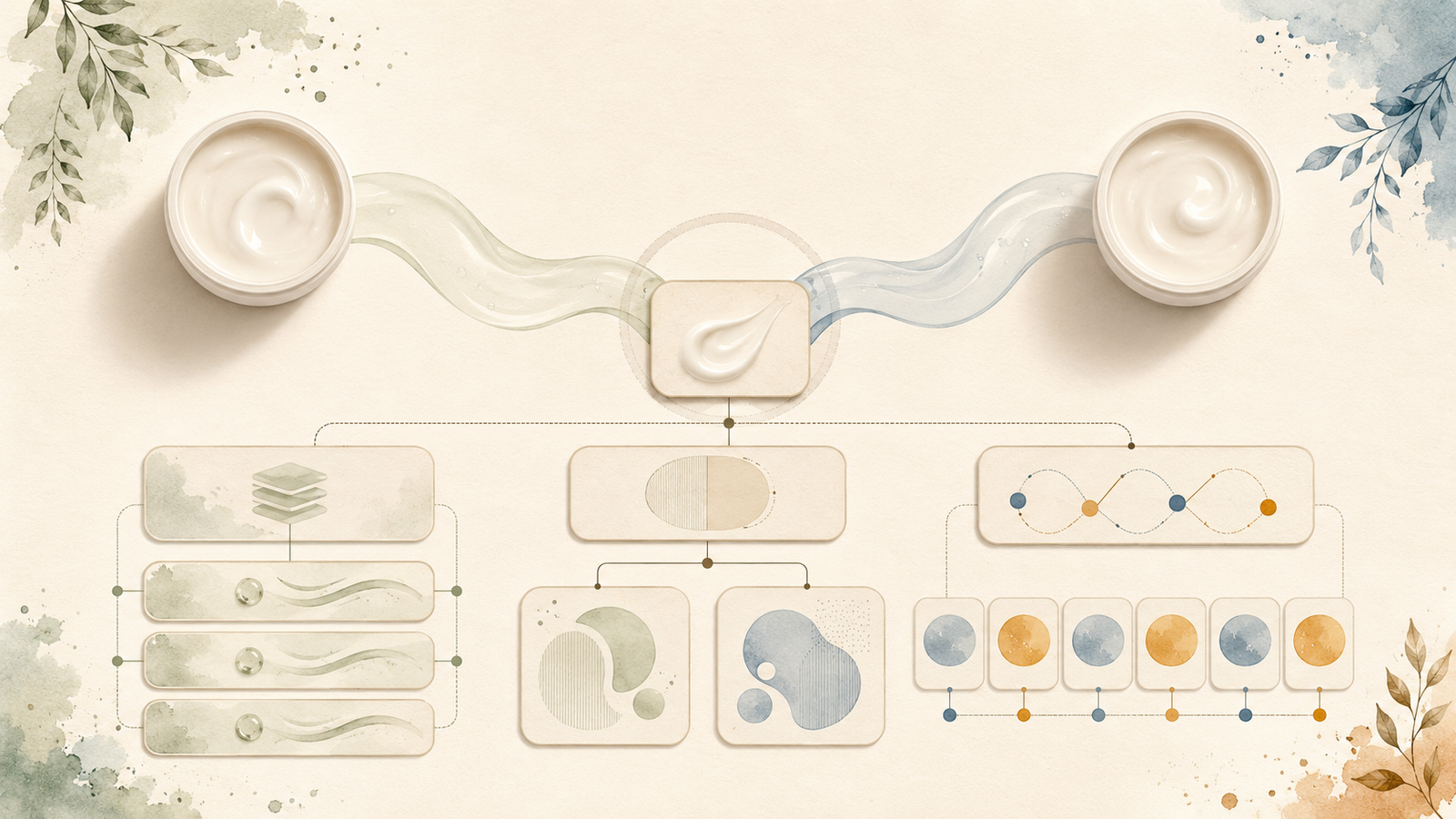
CeraVe Moisturizing Cream and Vanicream Moisturizing Cream can be mapped to the same moisturizer step, so using both on the same area in one session creates clear role overlap. That does not prove the combination is harmful, helpful, necessary, or redundant in performance. Neither current label tells buyers to mix or layer the pair, and no exact-pair public study in the reviewed evidence establishes an order or added result. Treat any two-product plan as a documented routine choice with material unknowns—not as a compatibility verdict.
Key facts and unknowns
The evidence supports a narrow routine-logistics analysis:
- the exact CeraVe object is the U.S. 16 fl oz non-pump Target listing with
TCIN 13977967andUPC 3606000537668; - the exact Vanicream object is the U.S. 16 oz non-pump Target listing with
TCIN 14768513andUPC 345334300014; - both manufacturer pages describe leave-on moisturizing creams for face and body and direct use as needed;
- both formulas declare water, petrolatum, cetearyl alcohol, and ceteareth-20, while their broader ingredient patterns differ;
- the ingredient lists do not reveal exact percentages, microstructure, film thickness, delivered amount, or the result of applying the products together;
- neither manufacturer direction reviewed for this article instructs the buyer to combine the products, mix them in the hand, or place one over the other;
- product-specific or multi-product studies found in the reviewed sources involve their own formulations, schedules, populations, and endpoints—not this exact retail pair;
- no texture, spread, absorption, pilling, residue, package use, or combined-wear observation was performed;
- price and value are outside this article’s decision scope;
- questions about diagnosed conditions, prescriptions, procedures, pregnancy, significant reactions, damaged skin, or individual suitability are outside this R1 guide.
The key distinction is between role overlap, which the public labels can support, and individual compatibility, which they cannot decide.
The exact routine question
This guide asks one bounded question:
Do the current public records show that these exact products fill different routine jobs, or do they occupy the same moisturizer step with unresolved combined-use questions?
It does not ask which cream is better. A direct CeraVe-versus-Vanicream buying comparison is a different task. It also does not decide whether a person should use either product, whether one should replace the other, or whether using both changes a medical condition.
The exact CeraVe product analysis and Vanicream product analysis are the published upstream records used for identity and version context; they do not establish exact-pair combined-use evidence. See also the published product-evaluation method for the gate-first limits applied here.
For the next routine decision, the published basic skin-care routine workflow explains how to avoid duplicating the same broad step, while the add-one-product workflow records a controlled change rather than a compatibility verdict.
The exact objects matter because both brands sell other sizes and package formats. A pump, refill, travel size, marketplace listing, older package, regional formula, or future reformulation is a different evidence object until identity and formula parity are checked. The current Target CeraVe listing and Target Vanicream listing supply the identifiers used here.
Both products occupy the moisturizer step
CeraVe’s current U.S. page places Moisturizing Cream in a routine sequence after cleansing, toning, and treatment and before daytime protection. It tells users to apply the cream liberally as often as needed to the face and body. See CeraVe — Moisturizing Cream.
Vanicream’s current page likewise describes Moisturizing Cream as a face-and-body moisturizer and says to apply it as needed. Its examples include use after bathing or other exposure, but the page does not create a separate treatment step or direct a second moisturizer over it. See Vanicream — Moisturizing Cream.
Those directions support the same category-level role:
routine role = leave-on moisturizer
routine placement = after cleansing or other earlier steps
frequency = as needed under the product’s own directions
exact combined-use instruction = not found in the reviewed labels
A shared category role does not prove that the products are identical. It does establish that a routine using both on the same area and occasion contains two products assigned to the same broad step unless the buyer records a narrower, evidence-supported purpose for each.
Formula overlap is real—but incomplete
Shared declared names
The current declarations for both exact product families include:
water
petrolatum
cetearyl alcohol
ceteareth-20
That shared set supports a broad formula-role interpretation. Water is the displayed vehicle. Petrolatum is commonly used in an occlusive context. Cetearyl alcohol and ceteareth-20 can contribute to cream structure, emollient context, or emulsification depending on the complete formula. General moisturizer reviews describe humectant, emollient, and occlusive roles as overlapping parts of formulation systems rather than sealed product categories. See Moisturizers: The Slippery Road and Vehicles for Drug Delivery and Cosmetic Moisturizers.
The overlap does not establish equal amounts, equal film formation, equal water-loss reduction, equal preservation, equal feel, or equal performance. A formulation review also explains why vehicle structure and ingredient interactions can affect topical behavior beyond ingredient names alone. See Formulation Effects of Topical Emulsions on Dermal Delivery.
CeraVe’s additional declared context
The captured CeraVe formula additionally lists glycerin, caprylic/capric triglyceride, cetyl alcohol, dimethicone, sodium hyaluronate, three named ceramides, cholesterol, phytosphingosine, and other formula-support ingredients. That creates a broader visible role map involving humectant, emollient or structural, occlusive or conditioning, and lipid-related names.
It does not disclose how much each material contributes, whether the current non-pump unit matches every web record, or how a layer behaves over or under Vanicream. The CeraVe refill page also warns buyers to check the package because ingredient information can change.
Vanicream’s shorter petrolatum-led declaration
The current Vanicream manufacturer page displays ten ingredient names: water, petrolatum, sorbitol, cetearyl alcohol, propylene glycol, ceteareth-20, simethicone, glyceryl stearate, PEG-30 stearate, and sorbic acid. Vanicream’s ingredient-function reference describes several of those materials by functions such as humectancy, emollience, emulsification, conditioning, and pH or microbial-growth control.
The same manufacturer page’s FAQ says the cream has “only 11 ingredients,” while its displayed ingredient list contains ten names. The exact Target listing for TCIN 14768513 and UPC 345334300014 currently displays those ten names plus BHT. This is a three-way source-display conflict, not proof that a physical unit was reformulated, mislabeled, or unsafe. No eleventh ingredient is inferred for the manufacturer list, and the Target BHT entry is not silently merged into the brand list.
What the ingredient lists cannot decide
U.S. ingredient declarations identify disclosed names and give limited order information. Ingredients at one percent or less have ordering flexibility, so the list does not provide exact percentages or a visible one-percent boundary. See FDA — Cosmetic Ingredient Names, FDA — Summary of Cosmetics Labeling Requirements, and 21 CFR 701.3.
For this routine question, the lists cannot establish:
- how thick a layer a person will apply;
- whether one layer changes the spread or drying of the other;
- whether the pair pills, rolls, separates, feels tacky, or leaves a heavier film;
- whether applying both changes the performance of either formula;
- whether a second layer is necessary for the buyer’s stated cosmetic goal;
- whether the formulas remain stable when physically mixed;
- whether the combined exposure is comfortable or suitable for an individual;
- whether a result observed with another cream or regimen transfers to this pair.
Those are finished-product, combined-use, observation, or individualized questions. Ingredient-name overlap is not the missing evidence.
Four routine scenarios—and what each can support
The table classifies routine plans without recommending one.
| Routine plan | What can be established from the plan | What remains unknown | Evidence-safe output |
|---|---|---|---|
| One cream replaces the other on the same area and occasion | One moisturizer slot is filled | Which product better matches the buyer’s constraint | Single moisturizer role; product-selection question remains separate |
| Both creams are applied to the same area in one session | Two products occupy the moisturizer step | Order, amount, feel, pilling, necessity, combined result, and individual response | Role overlap detected; exact-pair combination evidence limited |
| One cream is assigned to the face and the other to a different body area | The products have different location assignments | Whether either product performs as intended on that area or suits the person | Distinct-area logistics documented; no performance or safety verdict |
| One cream is assigned to one time or circumstance and the other to another | The products have different timing or context assignments | Whether the distinction improves results or is needed | Distinct-time logistics documented; benefit not established |
The third and fourth scenarios are not evidence that using both is better. They only show that a buyer can write a routine in which the products are not competing for the exact same place and moment. The labels do not establish the value of that plan.
Mixing, layering, and alternating are different evidence questions
Mixing in the hand
Neither reviewed manufacturer direction tells the buyer to combine CeraVe Moisturizing Cream and Vanicream Moisturizing Cream into one mixture. Physical mixing can change the immediate ratio, spread, and contact among formula components. Without an exact method and product evidence, this guide does not claim that the mixture is stable, uniform, beneficial, or equivalent to either product used as sold.
Layering in one session
Layering keeps the products more separate than premixing, but it still creates combined-use questions: which product is applied first, how much of each is used, how long the interval is, whether the first layer has changed before the second is added, and what endpoint is being assessed. No exact-pair public evidence in the reviewed set answers those questions.
Alternating by time or area
Alternating can make the routine roles operationally distinct, but the distinction must be recorded rather than assumed. “Morning versus evening,” “face versus body,” or “after bathing versus another occasion” is a logistics field. It does not prove that the split improves hydration, comfort, adherence, cost, or any other outcome.
Combination evidence does not transfer by category name
Published research can evaluate multi-product regimens, cream-plus-toner systems, or serum-plus-cream systems. Those studies are useful because they show what a real combination record needs: exact products or formulas, order, amount, schedule, duration, population, comparator, endpoints, funding, and conflicts.
One published study evaluated a defined topical regimen involving its own cream, toner, and spray under a specific protocol. See PMID 29394018. A separate study evaluated a named serum-plus-cream system and its own endpoints. See PMID 41906718. Neither study tested the exact CeraVe–Vanicream pair in this article.
The same transfer rule applies to product-specific records. A small study that included CeraVe Moisturizing Cream belongs to its tested product, participants, schedule, and endpoints; it is not a CeraVe-plus-Vanicream trial. See PMID 32947459. A historical physicochemical study naming Vanicream Moisturizing Skin Cream measured its own sample and properties; it does not establish the behavior of the current exact pair. See PMID 22527433.
The supported conclusion is therefore combination evidence not established for the exact pair, not “the products cannot be used together” and not “the products work better together.”
Brand claims and directory records do not settle routine fit
CeraVe’s pages present claims about ceramides, hyaluronic acid, MVE technology, fragrance-free status, non-comedogenic positioning, and long-lasting hydration. Vanicream’s pages present claims about fragrance and masking-fragrance exclusions, a short formula, non-comedogenic positioning, spread, absorption, and sensitive-skin use.
Those are first-party product claims. FDA states that cosmetic labeling must be truthful and not misleading and that claims involving treatment or effects on body structure or function can change a product’s regulatory status. See FDA — Cosmetics Labeling Claims and FDA — Is It a Cosmetic, a Drug, or Both?. FTC policy separately requires a reasonable basis for objective advertising claims. See FTC — Policy Statement Regarding Advertising Substantiation.
Both named products appear in the National Eczema Association directory. See the current entries for CeraVe Moisturizing Cream and Vanicream Moisturizing Cream. The association’s product-directory explanation says the Seal process is voluntary and is not an endorsement or a guarantee of an individual result.
Directory presence can verify program participation. It does not establish that the two products should be combined, that the pair is appropriate for a particular person, or that one label claim cancels uncertainty in the other product.
A repeatable routine-fit workflow
1. Freeze the exact objects
Record the product, market, size basis, package, seller identifier, UPC, ingredient declaration, directions, and checked date. Do not combine pump and non-pump records or a U.S. page with another market.
2. Write the routine job before looking for ingredients
Use a bounded statement such as “one leave-on moisturizer for this area and occasion” or “separate moisturizers for two documented areas.” Do not begin with an assumption that more layers are better or that one named ingredient requires a second cream.
3. Map each product to a category role
For this exact pair, both map to leave_on_moisturizer. That is the first overlap signal. It is not a product verdict.
4. Record narrower assignments
For each product, record area, occasion, and role. If both rows say the same area, same occasion, and same broad role, mark role overlap. If the rows differ, record the distinction without claiming a benefit.
5. Compare directions without rewriting them
Capture “apply as needed” and the stated face/body context. Do not invent an order, waiting interval, mixed ratio, or frequency for the pair.
6. Separate label evidence from combined-use evidence
An ingredient list can support disclosed identity. A brand claim can support what the brand says. A product study can support its tested object. None automatically supplies an exact-pair layering result.
7. Preserve the unknowns
At minimum, keep these fields visible:
exact_pair_combination_study = not located in reviewed evidence
manufacturer_combined_use_direction = not located
mixing_stability = unknown
layer_order = unknown
amount_per_layer = unknown
combined_sensory_result = unknown
combined_finished_product_result = unknown
individual_suitability = not assessed
8. Return one bounded output
A routine record can conclude:
- one moisturizer slot selected;
- role overlap detected;
- distinct-area logistics documented;
- distinct-time logistics documented;
- insufficient identity or direction information; or
- individualized question outside scope.
None of those outputs is a recommendation to use both products.
Common shortcuts that fail
“They share ingredients, so they must layer well”
Shared names do not disclose amount, vehicle, film behavior, or combined-use performance.
“Different ingredient lists mean the products do different jobs”
Both products are marketed and directed as moisturizers. Formula differences can matter without creating a separate routine category.
“Two moisturizers must be twice as moisturizing”
Two products do not create a linear dose-response rule. Amount, formula, application, environment, and endpoint remain unknown.
“The richer-looking formula should always go last”
No exact-pair evidence here establishes a universal order. Appearance, ingredient count, or product name is not a measured layering method.
“Mixing them saves a step”
Saving a movement is a logistics idea, not evidence that two finished formulas remain stable or perform as intended after mixing.
“A directory Seal proves the pair is safe for sensitive skin”
Program participation is not a personal-suitability guarantee and does not evaluate this two-product combination.
“No recall match means there is no product issue”
A negative search is not proof that no lot issue, complaint, market withdrawal, or future recall exists. FDA’s recalls and safety-alert page also notes the limits of current and archived search coverage.
“The labels say as needed, so any amount or frequency is supported”
“As needed” is the brand’s product direction. It does not define a combined amount, pair-specific schedule, or individualized plan.
When this guide is useful—and when to stop
Use this guide to identify category-role overlap, preserve exact product and direction context, distinguish premixing from layering or alternating, and decide whether a two-product plan has a documented logistical purpose.
Stop when the question becomes whether either product will diagnose, treat, prevent, or manage a condition; whether the pair is safe or appropriate for a particular person; how to use it with prescriptions or procedures; what to do during pregnancy or lactation; or how to respond to pain, swelling, blistering, a significant rash, broken skin, or another reaction. Those are not routine-logistics conclusions.
FDA explains that manufacturers are responsible for product safety and may use testing appropriate to their products; a public ingredient list is not the complete testing record. See FDA — Product Testing of Cosmetics. This article does not substitute for that evidence or for appropriately qualified individualized guidance.
Conflicts, risks, limitations, and unknowns
The most important conflict is not between the products. It is between what the routine question asks and what the public evidence can answer.
The labels support two moisturizer-step identities and different ingredient patterns. They do not support an exact-pair result. The current Vanicream source display diverges across the manufacturer list (10 names), manufacturer FAQ (11 ingredients), and exact Target listing (10 names plus BHT). The package formats were not inspected, so this does not establish a physical reformulation or formula parity. Manufacturer pages can change before retail packages change, and vice versa. Product-specific studies may involve older formulas or unmatched packages. Multi-product studies use other products and methods. Negative recall searches are incomplete.
The article also deliberately excludes price. Cost cannot decide whether two products have distinct routine roles, and including a dated price would not prove that using both is good value. Affiliate eligibility, ratings, popularity, and retailer convenience are not evidence for combined use.
No first-party observation was performed. Formula Clarity did not mix, layer, alternate, dispense, weigh, smell, spread, or wear the products. Texture and routine claims therefore remain unknown rather than being inferred from brand copy.
Methodology and evidence limitations
Formula Clarity applied its gate-first product-evaluation method to the exact Product A and the published Article 13 Product B record. Identity passes only for the bounded objects recorded above; the current manufacturer-versus-Target ingredient display conflict remains visible and unresolved. The ordinary evidence supports label, direction, and formula-role interpretation at E2. The observation gate remains not performed. The combined-use evidence is limited because no exact-pair method or result was located in the reviewed public set. The risk scope remains R1 only because individualized health and safety questions are excluded.
This method does not use a numeric aggregate score. A complete label cannot compensate for an unapproved Product B canonical binding, a missing exact-pair result, an unreviewed R2 question, or absent publication authority. CMS status and public release remain separate gates.
Sources
- CeraVe — Moisturizing Cream
- CeraVe — Moisturizing Cream Refill
- Target — CeraVe Moisturizing Cream, 16 fl oz non-pump
- Vanicream — Moisturizing Cream
- Vanicream — Ingredients and Functions
- Target — Vanicream Moisturizing Cream, 16 oz non-pump
- National Eczema Association — CeraVe Moisturizing Cream
- National Eczema Association — Vanicream Moisturizing Cream
- National Eczema Association — Product Directory
- FDA — Cosmetics Labeling Claims
- FDA — Is It a Cosmetic, a Drug, or Both?
- FDA — Product Testing of Cosmetics
- FDA — Cosmetic Ingredient Names
- FDA — Summary of Cosmetics Labeling Requirements
- eCFR — 21 CFR 701.3
- FTC — Policy Statement Regarding Advertising Substantiation
- Moisturizers: The Slippery Road
- Vehicles for Drug Delivery and Cosmetic Moisturizers
- Formulation Effects of Topical Emulsions on Dermal Delivery
- Defined cream/toner/spray regimen study
- Defined serum-plus-cream system study
- CeraVe-containing moisturizer study
- Vanicream-named physicochemical study
- FDA — Recalls, Market Withdrawals, and Safety Alerts