
Evidence: E2 — independently cross-checked across current U.S. regulator materials, dermatology-association consumer guidance, advertising-substantiation rules, and formal single-participant research-reporting standards used only to define what this simple log is not
Risk scope: R1 — ordinary cosmetic routine documentation and purchase/use traceability; no diagnosis, treatment, prescription change, reaction prediction, pregnancy guidance, or individualized safety conclusion
Direct observation: Not performed; Formula Clarity did not buy, open, apply, layer, remove, photograph, or test any product for this guide
Expert review: Not required for the retained R1 scope; not claimed
Evidence checked: July 26, 2026
Key limitation: A one-change log can improve traceability, but it cannot prove causation, compatibility, efficacy, safety, or suitability for a particular person
Next review: Before any CMS preview, after a material FDA, AAD, evidence-method, source, or workflow change, and no later than July 26, 2027
Quick answer
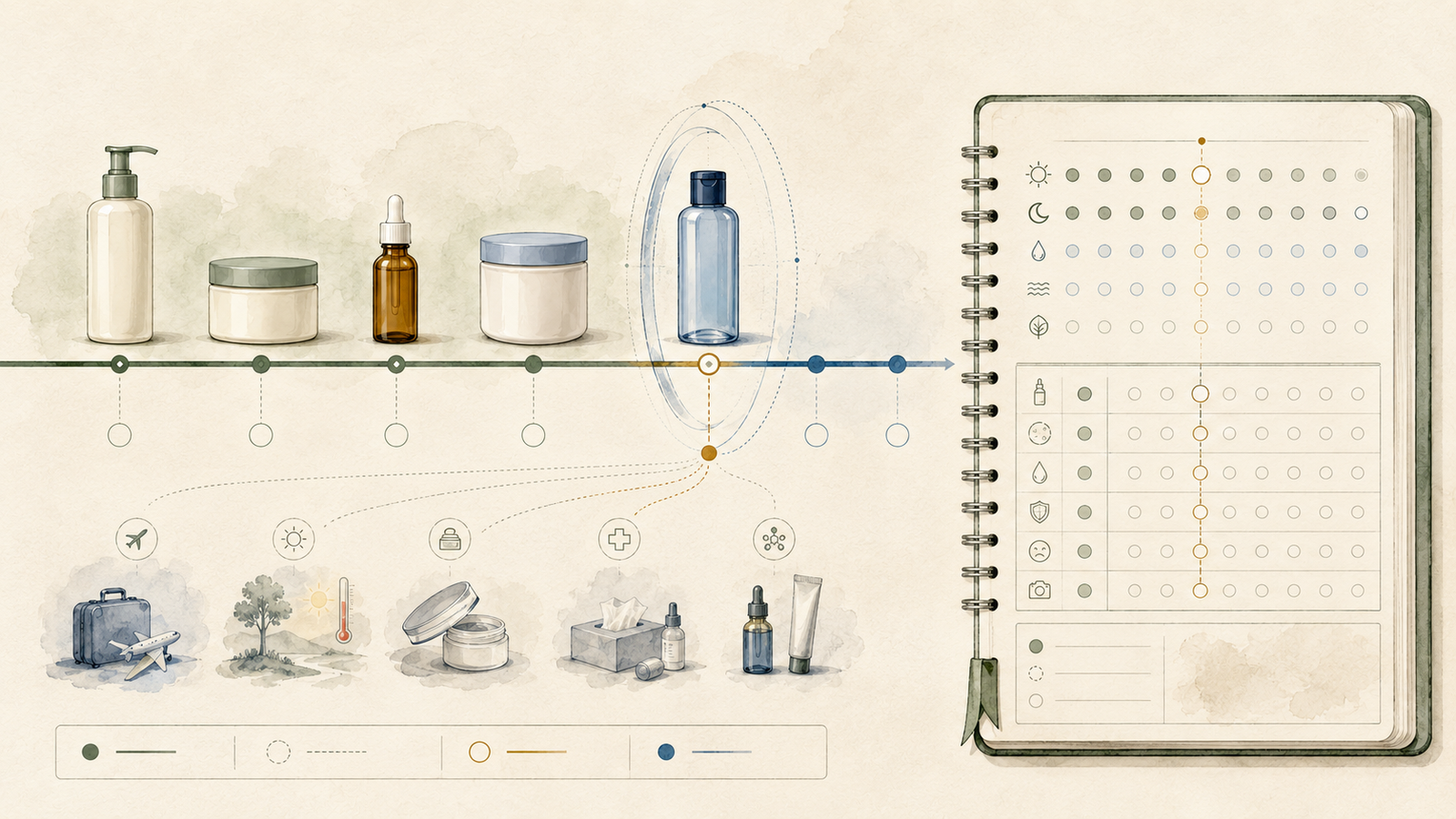
Freeze the current routine before adding anything. Identify one exact product and version, write one narrow cosmetic question, record the start date, area, occasion, order, labeled directions, and every other routine step you intend to keep unchanged. During the logging window, separate observations from explanations and mark any unplanned routine, product, package, medication, illness, travel, or environmental change. A clean log improves attribution; it does not turn personal notes into a controlled trial or a safety verdict.
Key facts and unknowns
The American Academy of Dermatology (AAD) has advised introducing one new skin-care product at a time. The cited article is written for teens and tweens, so it should not be converted into a universal adult treatment rule. The narrower operational lesson is useful for any documentation workflow: when several products change together, the record cannot cleanly identify which change accompanied a later observation. See AAD — A dermatologist’s guide to skincare. Before changing an established routine, see Build a Basic Skin-Care Routine Without Buying Duplicate Steps for the separate routine-job and duplicate-step context; that link is editorial context, not a product recommendation.
A routine log has three different evidence layers:
what was planned
what was actually done
what was observed
Those layers must stay separate from a fourth layer:
why the observation happened
The log can document that a new product was added before an observed change. It normally cannot establish that the product caused the change. Weather, travel, illness, stress, sleep, menstrual-cycle timing, another product, a medication, a package or formula change, application amount, frequency, and simple day-to-day variation can all remain unknown or uncontrolled.
Formal N-of-1 trials are prospectively planned, repeated crossover experiments with defined interventions, outcomes, periods, and analyses. The CENT 2015 statement and its explanation and elaboration show how much design and reporting are required before a single-participant experiment can support a stronger causal interpretation. A one-way consumer change log is not that design.
The biggest unknown is individual outcome. This workflow cannot decide whether a product is safe, effective, compatible, irritating, allergenic, medically appropriate, or worth continuing for a particular person.
What counts as one change
“One new product” means one exact purchase or use object entering one defined routine context at one recorded start point. It does not mean one brand family, one ingredient name, or one broad category.
Record the exact object:
brand and product name
variant or strength
market
size and package
UPC, TCIN, NDC, or other identifier when available
lot or batch when available after purchase
formula or ingredient-list version
current directions and warnings
seller and purchase date when relevant
A product with the same front name can change formula, package, size, claim, market, or regulatory status. If the formula or package version changes during the logging window, the object has changed even if the brand name has not.
A single product can still create a composite change. For example:
new product
+ new application area
+ new frequency
+ new layer order
+ removal of the old moisturizer
That may be a reasonable real-life decision, but it is not one isolated variable. The log must describe it as a composite change rather than pretending that only the product identity changed.
Step 1: Freeze the baseline routine
Before the new product starts, write down the routine that is actually in use—not the routine you intend to remember later.
For each existing item, capture:
exact product and variant
ordinary cosmetic, OTC drug, drug-cosmetic, or unclear
routine job
area
occasion or time of day
order
frequency as actually used
directions or Drug Facts that control use
known recent changes
Use routine jobs rather than marketing categories. A cleanser, moisturizer, sunscreen drug, and optional appearance-oriented cosmetic can each be mapped to a job. A toner, essence, serum, oil, mask, or mist does not earn a separate job merely because it has a different format.
The baseline is not “stable” merely because the product list is unchanged. A large change in frequency, amount, order, area, cleansing behavior, sun exposure, or another routine step can alter the context. When one of those fields changes, the log should mark the interval as changed rather than silently carrying the original baseline forward.
A baseline can return:
baseline_locked
baseline_incomplete
baseline_changed_before_start
Only baseline_locked is ready for a clean one-product logging window.
Step 2: Bind the exact new product
A marketing name is not enough. Capture the package, official page, ingredient declaration, directions, warnings, and Drug Facts when applicable.
U.S. cosmetic ingredient declarations identify names and provide limited ordering context. They do not disclose the complete formula, exact percentages, pH, manufacturing process, stability, delivery, or finished-product result. See FDA — Cosmetic Ingredient Names, FDA — Summary of Cosmetics Labeling Requirements, and 21 CFR 701.3.
Record label claims exactly and attribute them to the claimant. “Hydrating,” “barrier,” “gentle,” “clinically tested,” or “non-comedogenic” wording does not become an independently verified outcome because it appears on a retailer page. FDA states that cosmetic labeling must not be false or misleading, and the FTC requires a reasonable basis for objective advertising claims. See FDA — Cosmetics Labeling Claims and FTC — Advertising Substantiation.
If the exact product, formula version, or classification remains unclear, return:
new_product_identity_missing
Do not begin a causal story around an object that has not been identified.
Step 3: Write one narrow question
A usable question describes a routine or buying task that can be documented without making a medical claim.
Examples:
Does this exact cosmetic moisturizer fit the evening moisturizer job
without adding a second product to the same job?

Can this exact cosmetic serum be added before the current moisturizer
without changing the rest of the recorded routine?

Does the new package dispense in the way its public directions describe
under this one documented use context?
Questions that are too broad include:
Is this product good for my skin?
Is it safe for me?
Will it cure my acne?
Is it causing my rash?
Does it repair my barrier?
Is this the best product?
The first group can support a documentation workflow. The second group enters performance, diagnosis, treatment, reaction, safety, or universal-ranking territory that this R1 page does not resolve.
Write the question before the first full-routine use. A question written after the outcome is known can unintentionally select the most favorable interpretation.
The question status is:
question_predeclared
question_too_broad
question_outside_R1_scope
Step 4: Declare what will stay fixed
List the routine fields you plan to keep unchanged:
other products
area
occasion
order
frequency
cleansing step
sunscreen or other drug step
application tool
storage practice
This is a plan, not a promise. Real life changes. The purpose of the list is to make drift visible.
Do not stop, add, or alter a prescription, OTC drug, or medically directed step merely to create a cleaner cosmetic log. That decision is outside this workflow. A moisturizer with an SPF claim, an acne treatment, or another OTC drug must retain its Drug Facts and applicable directions. FDA explains that intended use can make a product a cosmetic, a drug, or both. See FDA — Is It a Cosmetic, a Drug, or Both?, 21 CFR 201.66, and 21 CFR 201.327.
When a drug or drug-cosmetic is present, the log may document the operational routine. It cannot override the label or evaluate treatment.
Step 5: Record the exposure context without inventing a dose
For each use, record only what can be supported:
date and local time
area
routine occasion
order
whether the product was used
amount basis, if known
frequency
rinse-off or leave-on status
other routine deviations
An amount can be:
label-directed
measured under a documented method
package actuation count
descriptive and explicitly approximate
unknown
Do not convert “one pump,” “a pea-sized amount,” “a thin layer,” or “a few drops” into grams or milliliters without a measured basis. Do not call an approximate amount precise.
The exact label controls rinse time, application frequency, sunscreen directions, and other operational instructions. This article does not invent a universal waiting period, layer order, trial length, or amount.
Step 6: Separate observation from interpretation
A useful entry distinguishes what was noticed from what it might mean.
| Observation field | Acceptable record | Unsupported upgrade |
|---|---|---|
| Use | Product used or skipped at a stated time | Adherence was perfect |
| Order | Product applied before or after another item | Order caused the outcome |
| Package | Pump failed, cap leaked, product was hard to access | Package is defective across all units |
| Appearance | Visible pilling, separation, color change, or residue was noticed | Formula is unstable or incompatible |
| Sensory | Odor, slip, tack, or finish was described | Typical experience for all users |
| Routine | Another product, amount, frequency, or area changed | The interval remained controlled |
| Skin note | A change was noticed and dated | The product caused, treated, or diagnosed it |
Use neutral wording:
observed after the change
temporally associated
cause not established
Avoid:
proved compatible
caused the reaction
fixed the problem
safe for me
detoxed the skin
repaired the barrier
A personal note can be real and important without becoming a causal or medical conclusion.
The change-log template
Use one row per routine occasion or one row per day when the chosen fields genuinely remain the same.
| Field | What to record | Why it matters |
|---|---|---|
| Log ID | A local identifier with no public personal data | Keeps entries traceable |
| Baseline version | The exact frozen routine record | Shows what was supposed to remain unchanged |
| New-product identity | Exact name, variant, package, market, and version | Prevents family-name drift |
| Start date | Absolute date and local time zone | Establishes sequence |
| Narrow question | One predeclared R1 documentation question | Limits post-hoc storytelling |
| Product class | Cosmetic, OTC drug, drug-cosmetic, or unclear | Preserves the label boundary |
| Directions captured | Yes, no, or not applicable | Shows whether operational use can be checked |
| Area and occasion | Exact area and routine occasion | Prevents unlike uses from being merged |
| Order | Recorded order or unknown | Makes layering drift visible |
| Amount basis | Label, measured, count, approximate, or unknown | Prevents invented precision |
| Other products | Same, changed, skipped, or unknown | Detects concurrent changes |
| External changes | Travel, illness, weather, medication, procedure, or other event; optional and local | Preserves possible confounding without diagnosing |
| Observation | Plain description | Separates record from inference |
| Interpretation status | Not attempted, evidence-limited, or outside scope | Blocks causal overclaiming |
| Interval status | Clean, changed, interrupted, or incomplete | Controls which entries can be compared |
| Source record | Label, Drug Facts, package, or official page checked | Keeps directions versioned |
The template is not a request to publish private health information. Formula Clarity does not need a reader’s personal diary, photos, symptoms, medication list, or identity to explain the method.
How to handle interruptions and confounders
A logging window becomes harder to interpret when another material field changes. Do not delete the entry. Mark what happened.
Use:
interval_clean
interval_changed
interval_interrupted
interval_incomplete
Examples of material changes include:
- adding, removing, or replacing another product;
- changing the amount, frequency, order, or area;
- switching to another package, size, market, lot, or formula;
- starting or stopping a medication or procedure;
- an illness, travel period, unusual environment, or other event the reader considers relevant;
- missing enough entries that actual use is unclear.
interval_changed does not mean the data are useless. It means the observation cannot be attributed to one isolated product change.
If the new product itself is reformulated or replaced, close the old interval and create a new identity record. Do not merge two formula versions because the front name stayed the same.
Addition, replacement, and dual-function cases
Addition
An addition keeps the existing routine and inserts one product. The log should identify the new job and whether it duplicates an existing one.
Replacement
A replacement removes one product and adds another. That is operationally one decision but two product-state changes. Record both. A later difference cannot be assigned only to the new product because the old product was also removed.
Dual-function product
A moisturizer with sunscreen may cover a moisturizer role and a UV-protection drug role. Record both roles and preserve the Drug Facts. The product may reduce container count, but the log cannot conclude that it provides better protection, adherence, compatibility, or value.
Package-only change
Changing from a jar to a pump with an otherwise matched product can still alter handling, amount, residue, or access. It is a package change, not “no change.” Without direct measurement, the log should not claim improved hygiene, dose consistency, or reduced waste.
Formula-version change
A reformulation is a new evidence object. Close the previous interval even when the product name and package look similar.
Small-area testing is a separate workflow
AAD publishes a small-area pre-use testing protocol for skin-care products. See AAD — How to test skin care products.
This Article does not reproduce that protocol as a universal safety test, shorten it, expand it to every product class, or claim that passing it guarantees future tolerability. A small-area test and a full-routine change log answer different questions:
small-area testing
= a separate professional consumer-guidance workflow

routine change log
= documentation of one defined routine change

neither
= universal safety clearance
Follow the exact source and product label rather than a simplified summary here.
Care-escalation and reporting boundary
This workflow stops when the question becomes diagnosis, treatment, pregnancy, prescription management, a significant reaction, toxicity, or individual safety. Those are not solved by adding more columns to a spreadsheet.
FDA maintains a current pathway for reporting cosmetic-product complaints and adverse events. Its reporting guidance asks for useful product-identification details such as the precise product name, place and time of purchase, lot number, labeling, and ingredients. See FDA — How to Report a Cosmetic Product Related Complaint.
A routine log can preserve those facts. It cannot determine medical severity, causation, diagnosis, or treatment. Use the FDA source and qualified care channels directly when that boundary is reached; Formula Clarity does not provide an individualized decision.
What the log can establish
A complete record can support statements such as:
this exact product was introduced on this date
the stated routine was otherwise unchanged in the recorded fields
the product was used in this area and occasion
this observation was recorded afterward
another material variable did or did not change in the log
the interval is complete, changed, interrupted, or incomplete
causation was not established
It can also reveal that the original question was not answerable because identity, directions, baseline, or actual use was missing.
What the log cannot establish
A routine log alone does not establish:
causation
clinical efficacy
compatibility
allergy
irritation mechanism
safety
diagnosis
treatment
typical-user experience
long-term stability
population-level frequency
regulatory compliance
universal value
Formal research uses pre-specified outcomes, repeated periods, comparators, analysis, and transparent reporting to strengthen causal interpretation. Even then, conclusions remain bounded by the design. A single consumer interval is better treated as structured documentation than as a personal clinical trial.
Worked synthetic cases
Case 1: one clean cosmetic addition
The baseline routine is documented. One exact cosmetic moisturizer is added to the evening moisturizer job. The other products, area, occasion, and order remain unchanged in the log. The result is:
observation_log_ready
causal_conclusion = not_supported
Case 2: cleanser and serum start together
Two products begin on the same date. The result is:
change_not_isolated
The entries may still be retained, but a later observation cannot be assigned to one product.
Case 3: old moisturizer removed and new moisturizer added
This is a replacement. The result is:
composite_replacement_change
The log must preserve both the removal and addition.
Case 4: moisturizer with SPF added
The exact product is a drug-cosmetic. Drug Facts are captured and the question is limited to routine placement. The result is:
log_ready_with_drug_label_boundary
The log does not evaluate sun-protection efficacy or replace the label.
Case 5: product family known, exact variant unknown
The result is:
new_product_identity_missing
A family name cannot support version-specific interpretation.
Case 6: travel and routine timing change during the interval
The result is:
interval_changed
The observation remains recorded, but the interval is not treated as one isolated variable.
Case 7: the question asks whether the product caused a rash
The result is:
blocked_r2_without_e4
The workflow preserves product identity and timing, then stops. It does not diagnose or assign causation.
Case 8: pilling is recorded after the new product
The log may record visible pilling, product order, amount basis, and concurrent changes. It does not conclude that either product is defective or chemically incompatible. A separate non-medical troubleshooting workflow would be needed.
Controlled outputs
Use one of these outputs:
baseline_not_locked
new_product_identity_missing
classification_unresolved
question_not_predeclared
change_not_isolated
composite_replacement_change
directions_missing
observation_log_incomplete
interval_changed
interval_interrupted
observation_log_ready
log_ready_with_drug_label_boundary
evidence_limited_no_causal_conclusion
blocked_drug_or_treatment_scope
blocked_r2_without_e4
A “ready” output means the documentation structure is usable. It does not mean the product passed a safety, efficacy, compatibility, or value test.
Common shortcuts that fail
“One bottle means one variable”
A product can change identity, role, area, frequency, order, amount, and package at once.
“I remember the old routine”
Memory is not a versioned baseline. Write the routine before the change.
“Nothing else changed”
If the record does not capture the relevant fields, the honest value is unknown, not “unchanged.”
“The product caused what happened next”
Sequence is necessary for causation, but sequence alone is not sufficient.
“A clean log proves compatibility”
A clean log improves traceability. It does not recreate formulation testing, clinical evaluation, or population evidence.
“Passing a small-area test proves the full routine is safe”
The AAD workflow is a separate guidance object and is not a universal guarantee.
“No immediate problem proves long-term suitability”
The absence of a recorded event in one interval does not prove future or individual safety.
“An ingredient name identifies the cause”
An ingredient declaration does not show exact amount, grade, vehicle, delivery, or the complete exposure history.
“A brand claim is the outcome field”
A brand claim belongs in the source record. The observation field records what was actually noticed.
“The log should contain every private detail”
Record only what is needed locally. Do not publish personal health, medication, identity, or image data to make the workflow look rigorous.
Refresh and correction rules
Start a successor log when any decision-critical object changes:
product or variant
formula or ingredient declaration
package or lot
market
directions or warnings
Drug Facts
routine job
area or occasion
question
baseline routine
Keep the old interval as a dated record. Do not overwrite it to make a later routine appear cleaner.
If an entry was wrong, correct it visibly with the original value, corrected value, date, and reason. A date-only refresh is not evidence that the underlying product or routine was rechecked.
Before any public CMS use of this article, recheck the AAD and FDA pages, confirm the exact Article format, verify that no R2 claim entered the body, and keep planned internal links inactive until both endpoints have passed public acceptance.
Methodology and evidence limitations
This guide applies Formula Clarity’s gate-first method to a bounded documentation task. The ordered gates are identity, evidence, risk, observation, comparison, price, commercial, and publication. Identity, risk, and observation are the material gates here.
The workflow is independently cross-checked against current public sources and tested with synthetic fixtures for internal consistency. Those fixtures show that missing identity, an unlocked baseline, multiple concurrent changes, an unclear regulatory class, a causal request, or an R2 question produce a blocked or limited output. The fixtures do not prove that a retail product is suitable, safe, effective, or compatible.
Formula Clarity did not conduct a clinical trial, N-of-1 trial, patch test, product use test, or package observation. This article provides a record structure, not medical advice, legal advice, a safety protocol, or a recommendation.
Sources
- AAD — A dermatologist’s guide to skincare
- AAD — How to test skin care products
- AAD — Skin care on a budget
- AAD — Facial masks and skin-care routines
- FDA — Is It a Cosmetic, a Drug, or Both?
- FDA — Cosmetics Labeling Claims
- FDA — Cosmetics Labeling Regulations
- FDA — Cosmetic Ingredient Names
- FDA — Summary of Cosmetics Labeling Requirements
- eCFR — 21 CFR 701.3
- eCFR — 21 CFR 201.66
- eCFR — 21 CFR 201.327
- FDA — Sunscreen Labeling and Effectiveness Testing
- FTC — Policy Statement Regarding Advertising Substantiation
- FDA — How to Report a Cosmetic Product Related Complaint
- FDA — Cosmetics & U.S. Law
- BMJ — CENT 2015 Statement
- BMJ — CENT 2015 Explanation and Elaboration