
Evidence: E2 — independently cross-checked across current U.S. labeling sources, primary solution-chemistry and formulation studies, and exact current product-label examples
Risk scope: R1 — routine logistics and evidence interpretation only; no diagnosis, treatment, reaction prediction, pregnancy guidance, prescription advice, or individualized safety conclusion
Direct observation: Not performed; Formula Clarity did not purchase, open, mix, layer, apply, store, photograph, assay, or otherwise test any product
Expert review: Not required for the retained R1 scope; not claimed
Evidence checked: July 27, 2026
Key limitation: A molecular interaction in a simple solution, a co-formulated retail ingredient list, or one brand’s regimen rule does not by itself establish universal compatibility or incompatibility for other finished products
Next review: By July 27, 2027, or sooner after a material formula, directions, compatibility-tool, study, regulator, or cited-product change
Quick answer
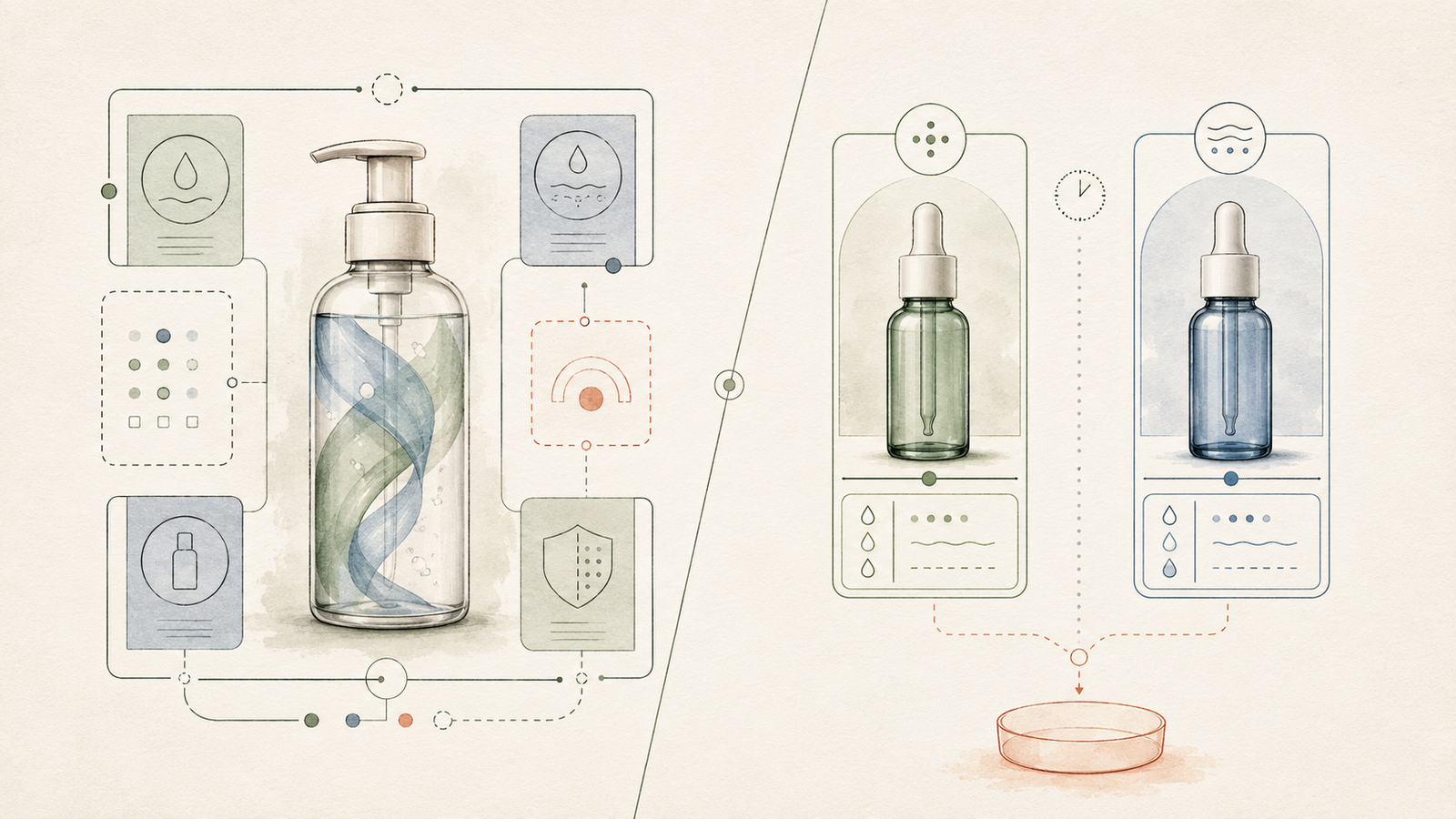
Vitamin C and niacinamide are not governed by one universal “never together” or “always compatible” rule. First identify the exact vitamin C form, whether the ingredients are in one finished formula or two separate products, and each product’s current directions. Simple-solution studies show that ascorbic acid and nicotinamide can interact under specific conditions, while current low-pH niacinamide research and co-formulated retail products show that acidic or combined systems can also be deliberately formulated. Follow exact product guidance, do not improvise premixing, and keep personal reaction or treatment questions outside this buying workflow.
For the separate question of what a label can verify about a niacinamide percentage, see Niacinamide Percentage Claims: How Much Can a Buyer Verify?.
For vitamin-C form and packaging limits, see Vitamin C Forms and Stability: A Packaging-First Buying Guide.
Key facts and unknowns
“Vitamin C” is a family label
A front label may say vitamin C, while the ingredient declaration names direct Ascorbic Acid or a derivative such as Ascorbyl Glucoside, 3-O-Ethyl Ascorbic Acid, Sodium Ascorbyl Phosphate, or Tetrahexyldecyl Ascorbate. Those are different chemical and formulation objects. U.S. cosmetic ingredient declarations help identify the named ingredient but do not normally disclose pH, exact percentage, retained amount, package-barrier performance, or delivery. See FDA — Cosmetic Ingredient Names, FDA — Summary of Cosmetics Labeling Requirements, and 21 CFR 701.3.
A compatibility statement that does not identify the vitamin C form is incomplete. Direct L-ascorbic acid in a low-pH aqueous serum, an oil-soluble derivative in an anhydrous formula, and a powder mixed by the user do not create the same chemistry, exposure, or routine question.
Niacinamide and nicotinamide identify the same compound
Niacinamide and nicotinamide are names used for the same compound. That identity helps match product labels to studies, but it does not make every concentration, vehicle, pH, package, or outcome interchangeable. See PubChem — Nicotinamide.
The exact claim still matters. A product name stating 10% niacinamide is a first-party quantitative claim for one version. Ingredient order cannot independently verify the percentage, and the number does not establish how the product behaves when layered with another formula.
Molecular interaction is not the same as a routine verdict
A 1963 solution study reported a pH-dependent yellow charge-transfer complex between nicotinamide and ascorbic acid in aqueous solution, with the reported association highest near pH 3.8 under that experimental system. See Solution Phase Interaction of Nicotinamide with Ascorbic Acid.
A later experimental and theoretical study detected hydrogen-bonding interactions between ascorbic acid and nicotinamide. See Hydrogen Bonding Interaction of Ascorbic Acid with Nicotinamide.
Another kinetic study exposed aqueous mixtures across pH 2–12 to a 30 W ultraviolet source and reported enhanced ascorbic-acid photodegradation in the presence of nicotinamide under those test conditions. See Photochemical Interaction of Ascorbic Acid and Nicotinamide in Aqueous Solution.
These studies support a narrow conclusion: the molecules can interact in defined solution systems, and light, pH, concentration, temperature, oxygen, and time can matter. They do not reproduce two separately packaged consumer products, the dilution and drying that occur after application, a complete emulsion or serum, or an ordinary routine without forced ultraviolet exposure. An interaction also does not prove that both ingredients become useless, that a visible color change will occur on skin, or that every finished formula is incompatible.
Low pH does not automatically make niacinamide unusable
A 2020 study compared niacinamide formulations at pH 3.8 and 5.8 in keratinocyte and three-dimensional skin-model experiments and reported stronger induction of selected autophagy-related measures in the lower-pH formulation. See Optimized Low-pH Niacinamide Formulation and ATG5.
A 2026 paper from Procter & Gamble researchers reported in vitro work and vehicle-controlled clinical studies of niacinamide formulations at pH 2.5–4. See Niacinamide and Low pH — In Vitro and Clinical Insights. All authors were company employees, and the published data belong to the exact formulas, methods, populations, and endpoints studied.
These records do not prove that every acidic product is stable, comfortable, or effective. They do show why the shortcut “niacinamide cannot exist in a low-pH formula” is too broad. Finished-product formulation, manufacturing, packaging, storage, and validation can matter more than an isolated pH slogan.
Ascorbic-acid stability is formula-specific
Direct ascorbic acid can be difficult to stabilize in water, but water alone does not decide the result. One study reported good long-term stability for an exact 3% ascorbic-acid oil-in-water emulsion and evaluated that specific formula. See Topical Activity of Ascorbic Acid: Formulation Stability and Use Study.
A separate study found greater stability for L-ascorbic acid in a low-moisture solid-in-oil system than in its aqueous control under the tested conditions. See Solid-in-Oil Nanosuspension Containing L-Ascorbic Acid.
The evidence-safe conclusion is not “water-based vitamin C is incompatible with niacinamide.” It is that the exact vitamin C form, vehicle, pH, water activity, antioxidant system, package, light exposure, oxygen exposure, and storage history must be kept with the evidence object.
Four different questions hidden inside “Can I use them together?”
1. Are both ingredients in one finished product?
When one current ingredient declaration lists niacinamide and a named vitamin C form, co-formulation is documented for that exact product version. That is stronger evidence of deliberate formulation than an internet rule based only on the two ingredient names.
It still does not disclose every percentage, manufacturing control, real-time stability result, retained concentration, delivery, or comparative performance. A co-formulated label supports same_finished_product_declared_coformulation; it does not support all_products_universally_compatible.
2. Can two separate products be used in the same session?
This is a product-pair and directions question. Capture the exact product versions, vitamin C form, pH if disclosed, vehicle, application directions, warnings, package, and any brand-specific conflict statement.
No primary source located for this packet recreates every possible retail pair, amount, layer order, interval, storage history, and user context. A same-session conclusion therefore remains evidence-limited unless the exact labels or an exact matched study support it.
3. Should the products be placed in separate routines?
Separate morning and evening routines can be a practical way to follow an exact brand instruction or to isolate a routine change. It is not proof that the molecules are universally incompatible.
If an exact page instructs separate routines, record that as brand_specific_separate_routines. Do not convert one company’s compatibility tool into a market-wide chemistry law, and do not ignore the instruction merely because another brand sells a different co-formulated product.
4. Can the products be premixed by the user?
Premixing is a different action from sequential layering. It changes concentration, pH, solvent balance, viscosity, preservative distribution, contact with air, and potentially the uniformity of the applied mixture.
Do not premix two finished products, add powder to a serum, or combine drops in the hand unless the exact directions explicitly instruct that action. A label-directed activation system is not evidence that arbitrary products can be mixed.
What current product pages show
The following examples were checked on July 27, 2026. They demonstrate evidence handling, not recommendations, rankings, product testing, or personal-use instructions.
| Exact current page | What is documented | What is not established |
|---|---|---|
| The Ordinary Niacinamide 10% + Zinc 1% | A water-based niacinamide serum, disclosed pH 5.00–6.50, and first-party guidance not to use it with direct or indirect vitamin C; its FAQ recommends separate routines | A universal chemical prohibition covering other brands, concentrations, forms, or finished formulas |
| The Ordinary Ascorbyl Glucoside Solution 12% | A water-based vitamin C derivative serum with disclosed pH 6.00–7.00 and a current ingredient declaration | Equivalence to direct L-ascorbic acid, independent conversion data for the sold product, or compatibility with an unmatched niacinamide product |
| CeraVe Skin Renewing Vitamin C Serum | A brand claim of 10% L-ascorbic acid, protective packaging, and a current direct-vitamin-C product object | Package oxygen transmission, retained concentration at each time point, or compatibility with a separate niacinamide product |
| Olay Super Serum Mini | A current ingredient declaration listing both Niacinamide and 3-O-Ethyl Ascorbic Acid in one finished formula | Universal compatibility of arbitrary vitamin C and niacinamide products or independent proof of every brand performance claim |
See The Ordinary — Niacinamide 10% + Zinc 1%, The Ordinary — Ascorbyl Glucoside Solution 12%, CeraVe — Skin Renewing Vitamin C Serum, and Olay — Super Serum Mini.
A second Olay product page lists niacinamide and 3-O-ethyl ascorbic acid in the same moisturizer. See Olay — Vitamin C Lightweight Hydrating Moisturizer. Multiple first-party examples show that co-formulation exists; they do not substitute for independent stability data or prove that all separate products can be layered.
The evidence asymmetry is deliberate:
one brand-specific separation instruction
does not prove universal incompatibility

one co-formulated ingredient list
does not prove universal compatibility
Both records can be true because they concern different formulas, forms, pH ranges, product claims, and development decisions.
Evidence object matrix
| Evidence object | What it can support | What it cannot support by itself |
|---|---|---|
| Compound identity record | Whether niacinamide and nicotinamide identify the same compound; whether ascorbic acid is a specific vitamin C form |
Finished-product stability, delivery, compatibility, or personal response |
| Ingredient declaration | Named ingredients in one current version | Exact amount, pH, retained concentration, hidden processing details, or outcome |
| Brand compatibility tool | The brand’s current product-specific instruction | A universal rule for other formulas |
| Co-formulated retail label | Both named ingredients occur in one finished formula | Independent stability, superiority, or arbitrary-pair compatibility |
| Simple aqueous-solution study | Interaction under defined concentrations, pH, light, temperature, and time | Ordinary layering of two complete retail products |
| Exact formulation study | Result for the studied formula, package, method, and endpoint | Transfer to unmatched products |
| Separate routine plan | A documented scheduling choice | Proof that same-session use is harmful |
| Direct observation | What was actually seen under a recorded protocol | Molecular cause, remaining potency, or personal safety without appropriate evidence |
Two combination studies illustrate the transfer limit. A clinical protocol used ascorbyl glucoside and niacinamide in a coupling gel with high-frequency ultrasound; another animal/procedure study used a multi-ingredient mixture delivered with microneedling. See Ultrasound-Enhanced Skin-Lightening Effect of Vitamin C and Niacinamide and Topical PDRN, Vitamin C and Niacinamide Mixture. These are exact procedure/formula objects, not evidence for an ordinary home routine, and they provide no instruction to reproduce the procedures.
A condition-focused study of a serum containing niacinamide, a stabilized vitamin C form, and other ingredients is retained only as a transfer-limit record. See Exact Multi-Ingredient Serum Clinical Study. This article does not use that study to offer condition treatment, compare the serum with another product, or advise an individual.
A bounded routine-compatibility workflow
1. Freeze the exact product objects
Record for each product:
product and variant
market
size and package
official page or package source
checked date
ingredient declaration
directions and warnings
formula-change or regional warning
A brand family name such as “vitamin C serum” is not enough. A direct-acid serum, derivative serum, powder, moisturizer, cleanser, and activated two-part formula are different objects.
2. Identify the exact vitamin C form
Classify the label as:
direct_ascorbic_acid
water_soluble_derivative
oil_soluble_derivative
powder_or_user_mixed_direct_acid
form_not_clear
Do not compare percentages across unlike molecules as though they describe the same amount or potency. See PubChem — Ascorbic Acid.
3. Distinguish one formula from two products
Use one of these paths:
same_finished_product
separate_products_same_session
separate_products_different_routines
user_premixing_or_activation
This decision changes what evidence is relevant. A finished product has one formulation and package object. Separate products introduce order, amount, drying, interval, and package-history questions. User mixing creates a new unvalidated mixture unless the label defines it.
4. Capture exact brand guidance
If the page says do not use with, use in separate routines, mix before first use, or another specific instruction, preserve the exact scope and date. The instruction controls the brand’s exact product-use record.
Do not broaden or weaken it. “Use separately” does not prove danger, and “no conflict listed” does not prove compatibility.
5. Do not invent a waiting-time rule
No universal five-minute, ten-minute, or thirty-minute interval was established by the sources in this packet. Record an actual interval only when the product directions specify it or when documenting a controlled routine change.
Waiting longer is not a verified repair for an unknown formula interaction. It may change texture or convenience without proving stability, delivery, or outcome.
6. Avoid arbitrary premixing
The Ordinary’s 100% L-Ascorbic Acid Powder and Drunk Elephant’s C-Firma Fresh mixing system are examples of user-mixing or activation instructions tied to exact products. They do not authorize adding any powder to any niacinamide serum.
An anhydrous oil-soluble derivative, such as The Ordinary Ascorbyl Tetraisopalmitate Solution 20% in Vitamin F, creates a different vehicle and percentage question from direct ascorbic acid. The front-label number cannot be normalized into a direct-acid dose or a compatibility score.
7. Change one routine variable at a time
When the exact labels do not prohibit the planned schedule and the question remains ordinary cosmetic routine logistics, document one change:
product added or replaced
same area and occasion
order used
actual interval
amount basis
other products held unchanged
visible observations
interruptions
Temporal sequence does not prove causation. Pilling, color, odor, tackiness, dryness, or another visible change does not identify the molecule responsible or measure remaining potency.
8. Preserve the unknowns
A useful closeout can read:
vitamin_c_form = captured
niacinamide_identity = captured
same_formula_or_separate_products = captured
current_directions = captured
brand_specific_conflict = present | absent | unknown
pH = disclosed | unknown
product_specific_stability = present | absent | unknown
premixing = not_authorized unless label-directed
universal_compatibility = not_established
universal_incompatibility = not_established
individual_suitability = not_assessed
9. Make only the supported conclusion
Supported:
This exact finished product declares both niacinamide and a named vitamin C derivative, so co-formulation is documented. Public evidence for its full stability method and transfer to other products remains limited.
Supported:
This exact brand page recommends separate routines for its niacinamide product and direct or indirect vitamin C. That instruction is product-specific and does not establish a universal chemistry rule.
Unsupported:
Vitamin C and niacinamide always cancel each other.
Unsupported:
Because one product contains both, every vitamin C serum can be layered with every niacinamide serum.
Common shortcuts that fail
- “The yellow complex proves the ingredients neutralize each other on skin.” The cited work used defined aqueous solutions; it did not test arbitrary finished products applied sequentially.
- “Niacinamide turns into niacin whenever the pH is low.” The packet does not support that universal conversion claim, and current low-pH niacinamide formulation studies directly contradict the idea that low pH alone makes niacinamide unusable.
- “A derivative is automatically compatible because it is not pure vitamin C.” Derivatives differ, and exact formula and directions still matter.
- “One brand says separate routines, so all brands must.” Brand guidance belongs to the named product and version.
- “Olay puts both in one serum, so every pair is compatible.” Co-formulation of one product does not validate an unmatched pair.
- “A longer wait solves the problem.” No universal interval was established.
- “Mixing in the hand is the same as layering.” Premixing changes the formula object before application.
- “No visible problem means no chemical interaction.” Appearance does not measure concentration, oxidation, delivery, or microscopic change.
- “Visible pilling or color proves incompatibility.” Those observations can have multiple causes and are not molecular assays.
- “The higher percentages should be used together for better results.” Percentage claims do not provide a matched combination study or a recommendation.
When this guide is useful—and when to stop
Use this guide to identify the exact ingredient forms, distinguish one finished formula from two products, preserve brand-specific directions, separate chemistry studies from retail-product evidence, avoid unsupported premixing, and document an ordinary routine change.
Stop the shopping workflow when the question becomes:
diagnosis or treatment
acne or pigmentation management
pregnancy or lactation
prescription or procedure advice
use on broken or actively inflamed skin
significant reaction interpretation
allergy prediction
toxicity
individual safety or suitability
Those are R2 questions. They are not answered by the words vitamin C, niacinamide, a pH number, or this article. FDA also explains that disease-treatment or structure/function claims can change the regulatory character of a product. See FDA — Cosmetics Labeling Claims and FDA — Is It a Cosmetic, a Drug, or Both?.
Conflicts, limitations, and unknowns
The article preserves several genuine tensions:
- simplified chemistry studies document interactions, but do not reproduce complete retail formulas;
- a brand-specific compatibility tool recommends separation, while other current finished formulas list both ingredient families;
- low-pH niacinamide studies show deliberate acidic formulations are possible, but do not validate every acidic product;
- a co-formulated label shows ingredient coexistence, but not every stability result or personal outcome;
- procedure-assisted combination studies show exact combinations have been investigated, but do not support ordinary routine instructions;
- ingredient declarations can change by time or market, and packages remain the operational reference.
Unknowns may include exact percentages, free ascorbic-acid fraction, pH, water activity, buffer system, oxygen exposure, light exposure, headspace, raw-material grade, manufacturing conditions, package transmission, real-time stability, amount applied, drying time, layer order, and individual response.
Formula Clarity did not purchase or test the products. No laboratory assay, package inspection, user trial, or direct observation was performed.
Methodology and evidence limitations
This article uses current U.S. regulator pages, government compound records, primary solution-chemistry and formulation studies, and exact current official product pages checked July 27, 2026. It separates brand instructions, ingredient declarations, simple-solution studies, exact formulation studies, procedure studies, and editorial conclusions.
The retained scope is R1. It does not decide treatment, reaction management, pregnancy, prescriptions, procedures, or personal suitability. It does not rank products, provide a universal layering schedule, authorize user premixing, or claim that either ingredient family is always compatible or always incompatible.
Objective brand claims require appropriate substantiation, but an official product page remains first-party evidence unless independent evidence supports the exact claim. See FTC — Policy Statement Regarding Advertising Substantiation.
Storage and package history remain relevant because air, light, temperature, and prior opening can change cosmetics. See FDA — Shelf Life and Expiration Dating of Cosmetics.
A 5% niacinamide study supports its exact formulation and study design, not a compatibility rule. See Niacinamide: A B Vitamin That Improves Aging Facial Skin Appearance.
Sources
- FDA — Cosmetics Labeling Claims
- FDA — Cosmetic Ingredient Names
- FDA — Summary of Cosmetics Labeling Requirements
- eCFR — 21 CFR 701.3
- FDA — Shelf Life and Expiration Dating of Cosmetics
- PubChem — Nicotinamide
- PubChem — Ascorbic Acid
- Solution Phase Interaction of Nicotinamide with Ascorbic Acid
- Hydrogen Bonding Interaction of Ascorbic Acid with Nicotinamide
- Photochemical Interaction of Ascorbic Acid and Nicotinamide in Aqueous Solution
- Optimized Low-pH Niacinamide Formulation and ATG5
- Niacinamide and Low pH — In Vitro and Clinical Insights
- Topical Activity of Ascorbic Acid: Formulation Stability and Use Study
- Ultrasound-Enhanced Skin-Lightening Effect of Vitamin C and Niacinamide
- Topical PDRN, Vitamin C and Niacinamide Mixture
- Exact Multi-Ingredient Serum Clinical Study
- Niacinamide: A B Vitamin That Improves Aging Facial Skin Appearance
- Solid-in-Oil Nanosuspension Containing L-Ascorbic Acid
- The Ordinary — Niacinamide 10% + Zinc 1%
- The Ordinary — Ascorbyl Glucoside Solution 12%
- CeraVe — Skin Renewing Vitamin C Serum
- Olay — Super Serum Mini
- Olay — Vitamin C Lightweight Hydrating Moisturizer
- The Ordinary — 100% L-Ascorbic Acid Powder
- Drunk Elephant — Mixing C-Firma Fresh
- The Ordinary — Ascorbyl Tetraisopalmitate Solution 20% in Vitamin F
- FDA — Is It a Cosmetic, a Drug, or Both?
- FTC — Policy Statement Regarding Advertising Substantiation