
Evidence: E2 — independently cross-checked across current U.S. regulator materials, dermatology-association consumer guidance, moisturizer and formulation literature, exact studies with transfer limits, and current label examples
Risk scope: R1 — general cosmetic routine planning and buying interpretation; no eczema or dermatitis treatment, diagnosis, reaction interpretation, prescription advice, pregnancy guidance, or individualized safety conclusion
Direct observation: Not performed; Formula Clarity did not buy, open, cleanse with, apply, layer, photograph, measure, or test any product for this guide
Expert review: Not required for the retained R1 scope; not claimed
Evidence checked: July 27, 2026
Key limitation: A routine can organize product jobs and evidence, but it cannot prove that a person’s skin barrier is damaged, select treatment, predict tolerability, or establish that one ingredient or product repairs the barrier
Next review: Before any CMS preview, after a material FDA, AAD, evidence-method, source, formula, label, or routine-workflow change, and no later than July 27, 2027
Quick answer
Build a barrier-support routine around jobs, not “repair” marketing. Use cleansing only for the removal task you can state, choose one moisturizer that combines the formula roles you actually need, add a separate surface-film product only when it has a distinct purpose, and treat daytime sunscreen as a Drug Facts step. Ceramides, glycerin, hyaluronic acid, petrolatum, and product texture are evidence clues—not guarantees. Keep exact labels, product classes, and unknowns visible, and stop before eczema, treatment, reaction, or personal-suitability decisions.
Key facts and unknowns
“Barrier support” is not one standardized U.S. cosmetic product class. In this guide it is a bounded editorial description for a routine that aims to reduce avoidable complexity, maintain a moisturized skin surface, and preserve clear product roles without claiming to diagnose or treat a condition.
FDA states that cosmetic claims must be truthful and not misleading. It also explains that a product marketed to treat or prevent disease, or to affect the structure or function of the body including the skin, is a drug under the law and must meet drug requirements. See FDA — Cosmetics Labeling Claims and FDA — Is It a Cosmetic, a Drug, or Both?.
That boundary matters when a page or package uses words such as repair, restore, strengthen, heal, treat, or protect. Record the exact wording and product class. Do not silently translate a brand’s “barrier repair” phrase into an independently verified clinical result, and do not translate a cosmetic routine into eczema care.
The routine’s largest unknown is individual outcome. Ingredient names, product formats, studies in selected populations, and brand claims cannot determine whether a product will feel comfortable, cause a reaction, fit a diagnosed condition, or be appropriate for a particular person.
Define the routine jobs before choosing products
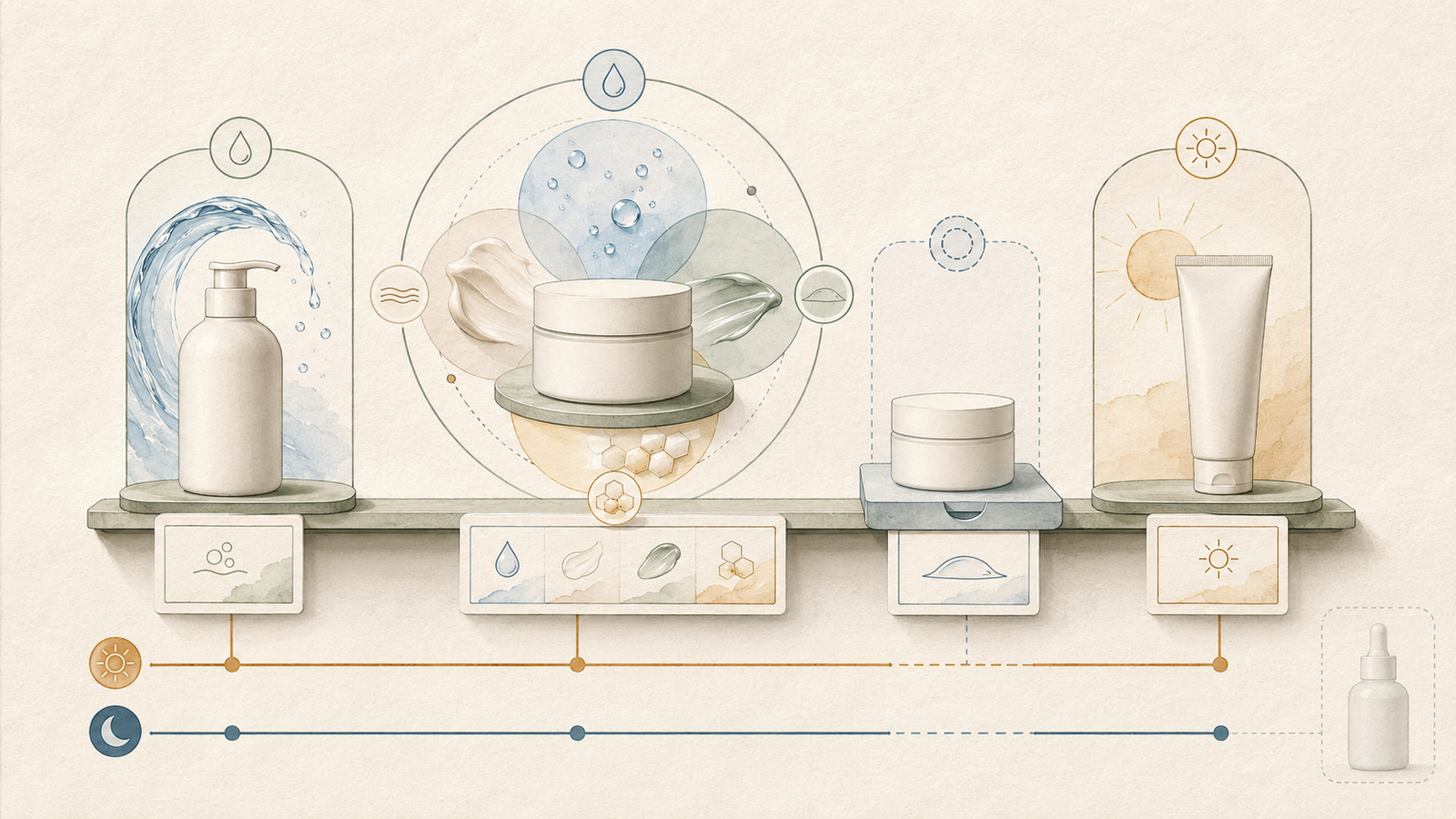
A barrier-support buying workflow begins with four possible jobs:
remove_or_cleanse_when_needed
moisturize_or_condition
optional_surface_film
daytime_uv_protection
The first three can involve cosmetics, drugs, or both depending on the exact intended use and label. Daytime sunscreen is a drug step in the United States. A fifth state is deliberately non-positive:
job_not_established
Use job_not_established when a product is being added because it is popular, expensive, trending, described as “barrier-safe,” or available through an affiliate program, but no distinct routine job has been documented.
Job 1: remove or cleanse when needed
The cleansing job is the removal task for a defined area and occasion: for example, removing sunscreen, makeup, visible soil, or accumulated product. Product format alone does not establish how much cleansing is needed, how often it should occur, or whether two cleansing products are duplicates.
The American Academy of Dermatology presents cleansing, moisturizing, and sun protection as a simple consumer framework and notes that limiting product count can reduce cost and potential irritation. See AAD — Skin care on a budget. Article 38 uses that as a job map, not a universal frequency prescription.
A cleanser’s ingredient declaration can show surfactants, glycerin, fatty alcohols, ceramides, or other materials, but the list does not reveal exact deposition, rinsing behavior, amount used, water temperature, contact time, or finished-product effect. A mild-cleanser study belongs to its exact formulation and protocol; it does not establish a universal “gentle” ranking for retail cleansers.
Job 2: moisturize or condition
A moisturizer is a formula system, not a single hero ingredient. Formula literature commonly groups relevant functions into overlapping humectant, emollient, and occlusive roles. See Moisturizers: The Slippery Road and Vehicles for Drug Delivery and Cosmetic Moisturizers. For the broader role framework, see the formula-role buying guide.
Humectants can help attract or bind water. Emollients can help smooth and soften the surface. Occlusives can help reduce water loss by forming a film. The roles overlap, and a material’s practical contribution depends on amount, vehicle, processing, interactions, and the complete formula.
A balanced moisturizer can occupy this job without a separate serum, oil, balm, or “barrier cream.” Adding another product requires a distinct reason that the first product does not already cover.
Job 3: add an optional surface film only when it is distinct
A separate ointment, balm, jelly, or oil may be considered when the stated cosmetic job is a more persistent surface film on a defined area or occasion. That is not an automatic requirement for a barrier-support routine.
An extra film-forming layer can duplicate the moisturizer job. It can also change feel, transfer, pilling, sunscreen behavior, or product-class obligations in ways the ingredient list cannot predict. If the additional product is an OTC skin protectant, its Drug Facts—not an ordinary cosmetic routine diagram—controls its uses, warnings, and directions.
The allowed conclusion is narrow: a separate surface-film product may fill a distinct role when its exact label, product class, area, and occasion are documented. The workflow does not decide that “slugging” is necessary, safe for everyone, or appropriate for a diagnosed condition.
Job 4: keep daytime UV protection as its own label-controlled step
A moisturizer with sunscreen may cover both a moisturizing job and a UV-protection job, but the sunscreen portion remains an OTC drug. Read the active ingredients, uses, warnings, directions, and water-resistance statement in Drug Facts. See 21 CFR 201.66 and 21 CFR 201.327.
Do not reduce the labeled amount, invent a waiting interval, or replace reapplication directions to make the product fit another layer. The routine map can identify the step; it cannot rewrite the label.
Use formula roles without turning them into a score
Humectant evidence is not a hydration guarantee
Glycerin and hyaluronic-acid-related materials can support a hydration-oriented formula role. Article 5’s evidence boundary remains important: glycerin is one defined small molecule, while hyaluronic-acid labels can refer to materials that differ by form, molecular weight, modification, concentration, and delivery context.
Seeing Glycerin, Hyaluronic Acid, or Sodium Hyaluronate supports declared presence for the exact label. It does not reveal exact amount, molecular-weight distribution, water activity, vehicle structure, duration, or finished-product result.
A randomized crossover study in 51 healthy volunteers with dry skin compared an exact emollient cream, its vehicle, and component variants. The complete cream showed combined effects associated with its glycerol and petrolatum components under that study design. The authors explicitly described a clinical pharmacology study rather than therapeutic benefit. See Combined effects of glycerol and petrolatum in an emollient cream.
That study supports complementary formula roles in one tested system. It does not prove that every product listing glycerin and petrolatum performs the same way, and it does not establish a routine for an individual.
Ceramide names are identity records, not a repair certificate
A current declaration may list Ceramide NP, Ceramide AP, Ceramide EOP, glycosphingolipids, glycolipids, or another lipid-related name. These are not interchangeable fields, and counting names is not a validated barrier score.
Ceramide and barrier-lipid research shows that species, chain-length distributions, ratios, vehicle, and physical organization can matter. A controlled study of exact barrier-lipid emulsions reported different recovery outcomes after experimentally induced damage, but those results belong to the exact mixtures, schedules, model, and endpoints. See Barrier-lipid emulsion study, ceramide chain-length model research, and a review of ceramide biophysical properties.
The evidence-safe conclusion is: a ceramide-related name can help identify formula context. It does not disclose amount, ratio, delivery, lamellar organization, stability, or a finished-product outcome.
Texture names are clues, not measurements
Gel, lotion, cream, balm, and ointment can suggest different formulation patterns, but the words are not standardized measures of oil phase, occlusion, residue, or film persistence. Two creams can have different role balances, and a lotion can contain meaningful emollient or occlusive components.
Use the exact declaration, product class, directions, and credible finished-product evidence. Do not assign a score merely because a product is called rich, intensive, barrier, recovery, or clinical.
A minimal barrier-support routine template
These templates are inventory and evidence tools. They do not set a universal product count, application frequency, or personalized regimen.
Daytime template
1. remove_or_cleanse_when_needed
2. moisturize_or_condition when a separate moisturizer job is retained
3. use the selected sunscreen drug product according to its Drug Facts
A moisturizer with sunscreen can fill jobs 2 and 3 only when the exact label supports both. The dual-function format does not erase Drug Facts or prove that the moisturizing performance equals a separate moisturizer.
Evening template
1. remove_or_cleanse_when_needed
2. moisturize_or_condition
3. add optional_surface_film only if the distinct job is documented
The evening template does not require toner, essence, serum, face oil, sleeping mask, or ointment. Each optional layer must state a job that is not merely a duplicate description of moisturization.
No-change result
A routine that already covers its documented jobs can return:
no_change_required
A new product launch, sale, sample, influencer routine, or “barrier reset” trend is not evidence that a job is missing.
Five current label examples—and what they actually show
The examples below were checked on July 27, 2026. They demonstrate label and product-class handling; they are not a shortlist, ranking, recommendation, or claim that Formula Clarity used the products.
1. CeraVe Hydrating Facial Cleanser
The current U.S. page identifies the product’s main job as cleansing, publishes an ingredient declaration containing glycerin, three named ceramides, sodium hyaluronate, cholesterol, and other materials, and gives rinse-off directions. The page also makes first-party barrier and delivery claims. See CeraVe Hydrating Facial Cleanser.
What the page supports:
- the brand’s current cleanser role and directions;
- the displayed ingredient names;
- the brand’s exact barrier-related wording.
What remains separate:
- independent verification of deposition or continued delivery after rinsing;
- the amount of each lipid or humectant;
- the buyer’s actual contact time, water temperature, and result;
- whether this cleanser is suitable for a particular person.
2. CeraVe Moisturizing Cream
The current U.S. page identifies a face-and-body moisturizing role and displays glycerin, petrolatum, dimethicone, three named ceramides, sodium hyaluronate, cholesterol, and phytosphingosine. It also uses multiple barrier-related brand claims and warns that ingredient lists are updated. See CeraVe Moisturizing Cream.
This example shows a visible humectant–emollient–occlusive–lipid context. It does not reveal exact ratios, independent package-specific testing, lot parity, personal feel, or superiority.
3. The Ordinary Natural Moisturizing Factors + PhytoCeramides
The current U.S. page identifies a rich moisturizer, lists glycerin, glycosphingolipids, glycolipids, fatty acids, sodium lactate, urea, sodium hyaluronate, amino acids, and other materials, and states that formulas may vary by time and region. It also reports a brand-sponsored hydration result and barrier-strengthening wording. See The Ordinary Natural Moisturizing Factors + PhytoCeramides.
The example shows why marketing vocabulary and ingredient vocabulary must be kept separate. PhytoCeramides does not translate automatically into Ceramide NP, and one brand test does not validate every barrier-support claim or every routine.
4. Foster & Thrive Petroleum Jelly
The current DailyMed label identifies white petrolatum USP 100% as the active ingredient and Skin Protectant as the purpose, with uses, warnings, and directions. See DailyMed — Foster & Thrive Petroleum Jelly.
This is not merely a generic cosmetic “occlusive.” It is an OTC drug label. The routine workflow must preserve that classification and may not replace its warnings or convert it into a universal facial-care recommendation.
5. PAPATUI Facial Moisturizer Broad Spectrum SPF 30
The current DailyMed label identifies zinc oxide 17% as a sunscreen active and also lists glycerin, panthenol, squalane, niacinamide, hyaluronic acid, ceramides, cholesterol, and other inactive ingredients. Drug Facts gives sunscreen uses, warnings, and directions. See DailyMed — PAPATUI Facial Moisturizer Broad Spectrum SPF 30.
This example can occupy two routine jobs on paper, but its sunscreen job remains label-controlled. The inactive-ingredient list does not prove a separate moisturizer’s performance, and the product’s multi-role name is not permission to alter sunscreen directions.
What routine studies can—and cannot—establish
A randomized investigator-blinded study compared a mild-cleanser-plus-moisturizer regimen with cleanser alone in 52 participants with moderate to severe dry skin over two weeks. The combined regimen improved several measured dryness outcomes under that exact protocol. See A consistent skin care regimen leads to improvements in dry human skin.
This study supports the proposition that a cleanser-and-moisturizer system can be studied as a regimen. It does not establish one universal cleanser, moisturizer, frequency, product order, or result. The selected dry-skin population, short duration, exact products, funding, endpoints, and control design limit transfer.
TEWL is also not a complete consumer verdict. Measurement research shows that TEWL can be influenced by environment, temperature, hydration, and the direction of the barrier question, and may be less sensitive to small changes after mild cleansing. See Directional assessment of the skin barrier function in vivo.
A measured endpoint can support a study conclusion. It does not establish comfort, appearance, long-term performance, or individual suitability unless those exact questions were measured appropriately.
Duplicate-step and change-control audit
Article 21’s routine principle is simple: define jobs before products and do not reward duplication. For the full non-duplicative workflow, see Build a Basic Skin-Care Routine Without Buying Duplicate Steps. Article 38 applies that principle to a barrier-support goal.
Ask four questions for every extra layer:
- What distinct job does this product perform?
- Is that job already covered on the same area and occasion?
- Does the exact label support the stated job and product class?
- What evidence remains unknown?
Common overlaps include:
| Pair | Possible overlap | What must be established before keeping both |
|---|---|---|
| Moisturizer + hydration serum | Water-binding or conditioning | A distinct job beyond a second hydration claim |
| Moisturizer + face oil | Emollient or surface-film role | Why the moisturizer does not already cover the intended finish |
| Moisturizer + petroleum jelly | Occlusive or skin-protectant role | Exact area, occasion, product class, warnings, and distinct film purpose |
| Moisturizer with SPF + separate sunscreen | Moisturizing and UV-protection jobs | Exact Drug Facts, label-compliant use, and whether duplication is intentional |
| Two “barrier creams” | Broad moisturizing or film roles | Exact formulas, labels, and a non-duplicative purpose |
A duplicate signal does not prove that either product is harmful, inferior, equivalent, or unnecessary. It means the routine record needs a clearer reason.
Change one documented variable at a time when the goal is traceability. Changing cleanser, moisturizer, occlusive layer, sunscreen, frequency, and application amount together makes it difficult to know what changed. This is a documentation principle, not a clinical testing protocol and not proof of causation.
A repeatable buyer workflow
Step 1: write a bounded cosmetic goal
Use a sentence such as:
I want a minimal routine that cleanses when needed, maintains a moisturized surface, and keeps sunscreen directions intact.
Do not start with “I need barrier repair” or “I need to treat eczema.” Those statements assume a condition or outcome that this guide cannot establish.
Step 2: freeze the exact product objects
Record product name, variant, U.S. market, size, package, current ingredient declaration, directions, Drug Facts when present, source, and checked date. Do not combine a current website claim with an old or different-market package.
Step 3: classify each product’s job and legal label context
Use:
ordinary_cosmetic
OTC_drug
cosmetic_and_OTC_drug
classification_unresolved
A skin protectant or sunscreen cannot be handled as an ordinary cosmetic merely because it is sold in the skin-care aisle.
Step 4: map formula roles without counting ingredients
Record possible humectant, emollient, occlusive, and lipid-context clues. Preserve overlap. Do not award points for more names, more ceramides, a higher list position, or a richer texture label.
Step 5: separate evidence objects
Keep these fields distinct:
brand_claim
ingredient_declaration
regulatory_classification
material_or_ingredient_study
exact_formulation_study
exact_finished_product_study
direct_observation
unknown
A brand claim is not independent confirmation. An ingredient study is not finished-product proof. A routine study is not proof for unmatched retail products.
Step 6: test for duplicate jobs
Compare area, occasion, stated reason, product class, and expected role. Keep both products only when the distinct purpose is documented without inventing performance.
Step 7: preserve unknowns
A useful record can say:
cleanser_job = documented
moisturizer_job = documented
optional_surface_film = held | documented_with_limits
sunscreen_Drug_Facts = captured | missing
formula_roles = partial
finished_product_evidence = exact | related_only | absent
individual_suitability = not_assessed
Step 8: make only the supported conclusion
Supported:
This routine assigns one product to each documented job, preserves Drug Facts where applicable, and uses formula-role evidence without claiming treatment or personal suitability.
Unsupported:
This routine repairs every damaged barrier and is safe for eczema-prone skin.
Common shortcuts that fail
“Ceramides mean the routine repairs the barrier”
A ceramide name supports declared presence. It does not disclose amount, ratio, delivery, organization, stability, or exact finished-product performance.
“Glycerin or hyaluronic acid is enough by itself”
Humectant names do not show the surrounding emollient and occlusive system, product amount, duration, or result.
“A thick cream is always more protective”
Texture names are not standardized occlusion measurements. Verify the complete formula, label, and evidence.
“Petroleum jelly is just another moisturizer”
Some white-petrolatum products are OTC skin protectants with Drug Facts. Classification, warnings, and intended use must remain visible.
“A moisturizer with SPF lets me ignore sunscreen directions”
The sunscreen remains a drug step. Follow the exact Drug Facts.
“More layers mean more barrier support”
More layers can mean repeated jobs, more variables, more cost, and more unknown interactions. Product count is not a validated outcome score.
“No stinging means the routine is working”
Absence of one sensation is not a measurement of barrier function, and the article does not diagnose or monitor a condition.
When this guide is useful—and when to stop
Use this guide to organize a low-complexity cosmetic routine, compare formula-role evidence, detect duplicate jobs, preserve product-class boundaries, and identify what evidence is still missing.
Stop this buying workflow when the question involves diagnosed eczema or dermatitis, treatment, a prescription, a recent procedure, broken or actively inflamed skin, a significant or persistent reaction, pregnancy or lactation, or a request to determine personal safety or suitability. Those questions require appropriately qualified care and exact-scope evidence outside this R1 article.
Methodology and evidence limitations
This article uses current U.S. regulatory and Drug Facts materials, AAD consumer guidance, peer-reviewed moisturizer and barrier literature, exact studies with transfer limits, and five current label examples checked July 27, 2026. It does not purchase or test products, diagnose a barrier problem, prescribe a routine, establish a universal frequency, or rank products.
Brand pages are first-party evidence for their own current wording and displayed declarations. DailyMed records are label evidence for exact OTC drug objects. Peer-reviewed studies support conclusions only within their exact formulations, populations, comparators, durations, endpoints, and conflicts. Canonical Articles 4–6 provide the project’s formula-role, humectant, and ceramide evidence boundaries. Article 21 remains a staged upstream reference until its canonical payload and admission are verified.
Sources
- FDA — Cosmetics Labeling Claims
- FDA — Is It a Cosmetic, a Drug, or Both?
- FDA — Summary of Cosmetics Labeling Requirements
- FDA — Cosmetic Ingredient Names
- 21 CFR 701.3
- AAD — Skin care on a budget
- 21 CFR 201.66
- 21 CFR 201.327
- FDA — Tips to Stay Safe in the Sun
- Moisturizers: The Slippery Road
- Vehicles for Drug Delivery and Cosmetic Moisturizers
- Glycerol and the skin
- Combined effects of glycerol and petrolatum
- Ceramide chain-length model research
- Review of ceramide biophysical properties
- Barrier-lipid emulsion study
- Consistent cleanser-and-moisturizer regimen study
- Formulation effects of topical emulsions
- Directional assessment of skin barrier function
- CeraVe Hydrating Facial Cleanser
- CeraVe Moisturizing Cream
- The Ordinary Natural Moisturizing Factors + PhytoCeramides
- DailyMed — Foster & Thrive Petroleum Jelly
- DailyMed — PAPATUI Facial Moisturizer Broad Spectrum SPF 30
- FTC — Advertising Substantiation Policy Statement