Evidence: E2 — independently cross-checked across current U.S. consumer-protection and cosmetics guidance, brand authorization records, retailer and marketplace terms, exact seller-of-record fields, return policies, and dated product-price examples
Risk scope: R1 — general purchase-channel, seller, price, shipping, return, and evidence interpretation; no product-authenticity determination for a received unit, legal advice, fraud adjudication, medical interpretation, or individualized safety conclusion
Direct observation: Not performed; Formula Clarity did not place an order, contact a seller, inspect a package, verify a lot code, make a return, dispute a charge, or authenticate any product
Expert review: Not required for the retained R1 scope; not claimed
Evidence checked: July 27, 2026, United States
Key limitation: A purchase channel can provide seller identity, authorization evidence, transaction terms, and remedies, but it cannot by itself prove that an exact unit is authentic, fresh, undamaged, correctly stored, or suitable for a person
Next review: Before any CMS preview, after a material FTC, FDA, INFORM Act, brand authorization, seller, marketplace, return, shipping, price, or evidence-method change, and no later than July 27, 2027
Quick answer
Separate the website, seller of record, and fulfiller before comparing a brand store, an authorized retailer, or a marketplace listing. Verify authorization on a current brand-owned U.S. page, then record the exact seller, item page, price, shipping, return window, condition rules, refund owner, and date. A marketplace guarantee or generous return policy is a remedy, not product authentication. A lower displayed price is not a value verdict until checkout costs, seller terms, quantity, and the approved price method are known.
Key facts and unknowns
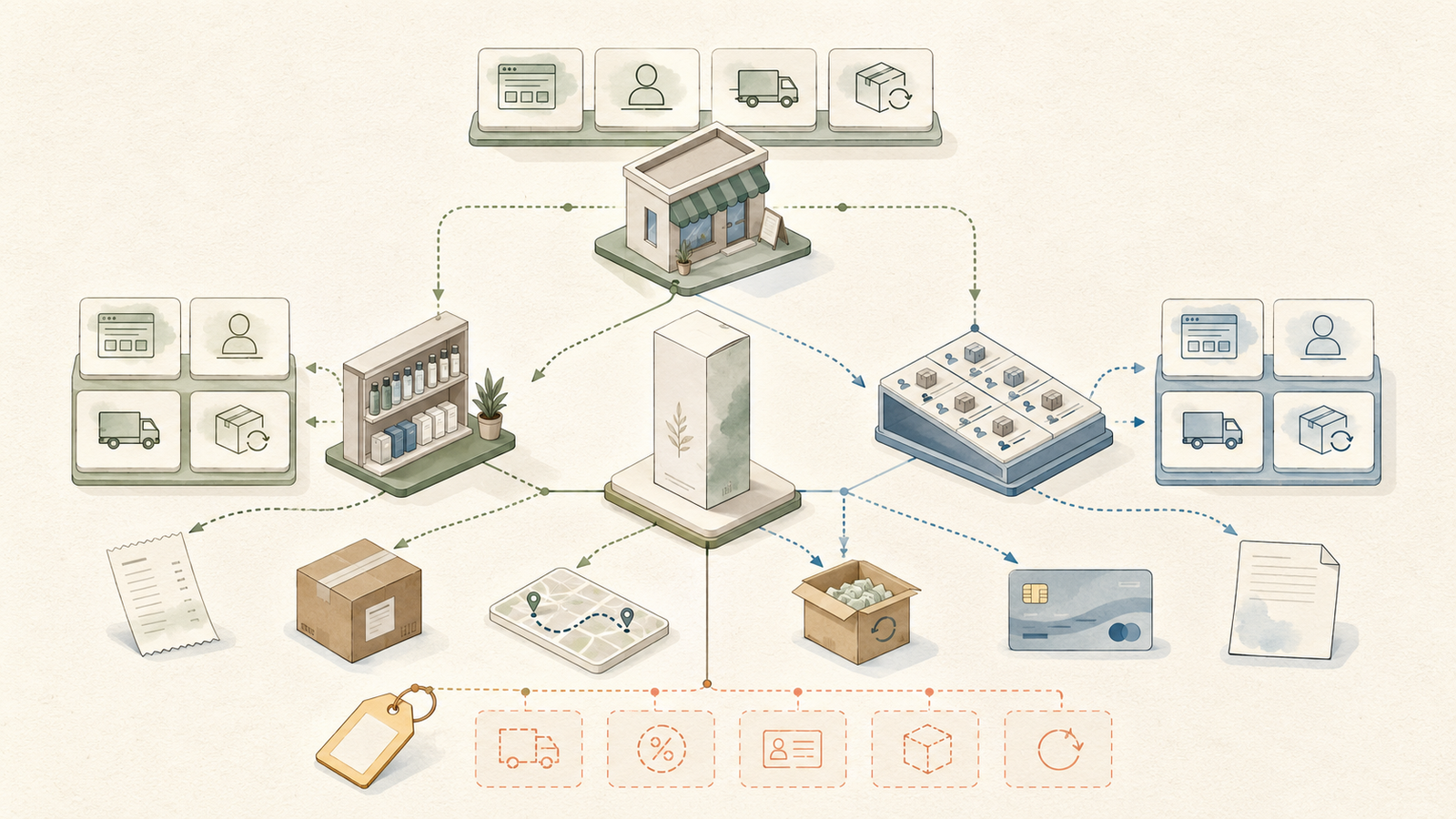
A familiar domain is not one uniform sales channel. A brand website can operate its own checkout, link to professionals, or simply publish product information. A large retailer can sell its own inventory and also host third-party sellers. A marketplace can process payment while the seller ships the item, or the platform can fulfill an item owned by a third party. Each arrangement creates different evidence and different return responsibilities.
The website, seller, and fulfiller are separate records. Before relying on a listing, capture the platform domain, the seller of record, the party shown as shipping or fulfilling the order, the exact item identifier, the market, and the checked date. Do not replace those fields with a broad label such as “bought from Walmart,” “bought on Amazon,” or “bought from the brand.”
The Federal Trade Commission advises online shoppers to identify the company, read the product description, preserve records, and review shipping and refund terms. It also says sellers must ship within the promised time or, if no time is stated, generally within 30 days under the Mail, Internet, or Telephone Order Merchandise Rule. See FTC — Online Shopping, FTC — Shopping online? Know your retailer and your rights, and FTC — Mail, Internet, or Telephone Order Merchandise Rule.
The largest unknown remains the exact received unit. Public pages do not establish its chain of custody, storage temperature, prior opening, lot identity, fill condition, seal integrity, or formula parity with the page. Formula Clarity has no direct evidence about any unit discussed here.
Define the channel without turning it into an authenticity verdict
This guide uses six channel states:
brand_direct_store
brand_authorized_retailer
retailer_owned_inventory
marketplace_platform_fulfilled
marketplace_seller_fulfilled
channel_or_seller_unresolved
These are transaction classifications, not product-quality grades. A direct brand store can still have shipping damage or a return dispute. An authorized retailer can have a different promotion, inventory age, or return policy from the brand. A marketplace listing can document a seller and offer a remedy without supplying brand authorization for that seller.
Brand direct store
Use brand_direct_store only when the brand controls the checkout and is the seller of record for the exact market. A brand-owned informational page that redirects elsewhere is not automatically a direct store. Record who charges the card, who sends the confirmation, who ships the order, and who accepts the return.
Direct purchase can create channel-specific benefits. SkinCeuticals, for example, states that its VIP Skinsider program counts purchases made on SkinCeuticals.com, not purchases at authorized retailers or skincare professionals. See SkinCeuticals — VIP Skinsider program. That is a loyalty-program difference, not evidence that an authorized retailer’s product is inferior.
Brand-authorized retailer
Use brand_authorized_retailer only when a current brand-owned source identifies the retailer for the same market. Preserve the brand page, retailer name, market, access date, and any wording that limits the authorization to particular domains, professionals, or seller configurations.
Authorization is a relationship record. It can support that the brand publicly recognizes a sales route. It does not independently prove the condition of a particular package, the product’s storage history, or the outcome of a return. It also does not transfer the brand store’s rewards or return policy to the retailer.
Retailer-owned inventory
A retailer-owned listing should show the retailer as seller of record, not merely the website name. Brand guidance may add stricter seller-and-fulfiller wording. CeraVe’s current U.S. where-to-buy guidance, for example, distinguishes listings sold and shipped by Amazon.com or sold and shipped by Walmart.com from third-party sellers on those platforms. See CeraVe — Where to Buy and CeraVe — Frequently Asked Questions.
That wording belongs to CeraVe’s current policy. It should not be generalized into a rule that platform fulfillment proves authorization for every brand.
Marketplace listing
For a marketplace listing, record at least:
platform
seller_of_record
fulfiller_or_shipper
exact_item_page
item_identifier
return_owner
return_window
price_and_checked_date
brand_authorization_source
The platform may provide payment, customer-service, or return infrastructure while the third-party seller remains responsible for the inventory. The platform’s name in the URL does not erase the seller field.
Unresolved channel
Use channel_or_seller_unresolved when the page does not clearly identify the seller, the item page changes sellers during checkout, the authorization source is stale or market-mismatched, or the return owner cannot be determined. Missing identity is not a favorable signal.
What an authorized-retailer record can—and cannot—support
A current brand-owned authorization page is stronger evidence of a brand–retailer relationship than a retailer badge, a marketplace seller’s display name, or a search snippet. The evidence-safe workflow is:
- open the brand’s current U.S. authorization page or store locator;
- confirm the exact retailer domain or professional channel;
- check whether the brand limits authorization to a specific seller or fulfillment arrangement;
- save the access date and exact wording;
- keep the exact order receipt and seller field separate from the brand record.
SkinCeuticals currently lists Dermstore among its authorized online retailers. It also warns about purchases outside its listed channels. See SkinCeuticals — Authorized Retailers and SkinCeuticals — Purchasing and diversion.
Those are first-party brand statements. They support the authorization classification used in this guide. They are not an independent laboratory authentication of every item sold by a listed retailer, and they do not establish that an unlisted item is counterfeit.
A seller name containing words such as authorized, official, premium, or beauty distribution is not the brand’s authorization record. Treat the name as seller-identification evidence only until the brand’s current market-specific source confirms the relationship.
Marketplace transparency helps identify parties; it does not authenticate products
The INFORM Consumers Act requires online marketplaces to collect and verify specified information from covered high-volume third-party sellers and to disclose identifying information for certain sellers, subject to statutory thresholds and exceptions. It also requires a way to report suspicious marketplace activity. See FTC — INFORM Consumers Act and FTC — Online marketplaces notice about INFORM responsibilities.
The law improves seller transparency for covered listings. It does not certify a product, verify a cosmetic lot, or make every third-party seller subject to the same disclosure. The FTC’s first INFORM enforcement action, announced against Temu in 2025, concerned required seller disclosures and reporting mechanisms. It does not create a product-authentication result for unrelated listings. See FTC — First INFORM enforcement action against Temu.
Marketplace protections must be classified as remedies. A return pathway, buyer guarantee, payment dispute process, or report button can reduce transaction risk or help after a problem. It does not prove what is inside the package before purchase. See Amazon Pay — A-to-z Guarantee for one platform-specific remedy example.
Return policy follows the transaction, not the brand name
A product’s brand does not necessarily own the return. The order channel normally controls where a return starts, what condition is accepted, who pays return shipping, whether restocking applies, how the refund is issued, and how long processing may take.
SkinCeuticals states that items purchased on SkinCeuticals.com may be returned to SkinCeuticals within 30 days under its stated conditions, while products purchased elsewhere must be returned to the original point of purchase. See SkinCeuticals — Shipping and Returns.
Dermstore currently states a 60-day initiation window for eligible returns, but requires items to be in pristine condition—unopened, unused, and with seals intact—unless the item is damaged, faulty, or incorrect and handled through customer service. See Dermstore — Return Policy. A longer window is not automatically a more permissive policy when condition requirements differ.
The Ordinary’s U.S. direct policy allows qualifying direct purchases to be returned under its stated one-year and remaining-product conditions, while purchases made through retail partners follow the partner’s return policy. See The Ordinary / DECIEM — Return Policy. The same product can therefore have different return rights depending on seller and receipt.
Large retail domains can also contain two policy tracks. Target says most unopened Target-sold items have a 90-day window, while most unopened Target Plus partner items have a 30-day window, subject to item-specific exceptions. See Target — Returns.
Walmart’s policy likewise distinguishes Walmart-sold items from Marketplace items. The policy updated June 1, 2026 says most Marketplace items are returnable within 30 days, seller terms can differ, and marketplace returns may involve seller responsibility and possible restocking fees. See Walmart — Return Policy.
A useful return record includes:
return_owner
window_start_event
window_length
item_condition_required
opened_or_used_item_rule
return_shipping_owner
restocking_or_other_fee
refund_method
refund_processing_time
proof_of_purchase_required
item_specific_exception
Do not summarize the record as “easy returns” without preserving the actual conditions.
Shipping and payment rights are separate from authorization
The FTC order rule requires a reasonable basis for a promised shipping time and, when the seller cannot ship on time, a delay option or refund. That rule applies to fulfillment promises; it does not establish brand authorization or product condition.
The FTC also advises keeping records of the company, website, receipt, payment, and shipping promise. Credit-card billing disputes can provide a route when goods are not delivered or differ from the order, subject to applicable requirements and deadlines. See FTC — So an online scam is not what you ordered? and FTC — Using credit cards and disputing charges.
A warranty is another separate evidence object. Record who provides it, what it covers, how to make a claim, and whether proof of purchase from a particular seller is required. See FTC — Warranties. Do not assume that a platform return window equals a manufacturer warranty.
Price trade-offs require the exact transaction context
The displayed product price is only one field. Before comparing channels, record:
sticker_price
currency
seller_of_record
fulfiller
shipping
estimated_tax
membership_requirement
subscription_requirement
coupon_or_promotion
minimum_order_threshold
return_shipping
restocking_or_other_fee
refund_method_and_timing
checked_date
Taxes, location, stock, selected seller, membership state, and checkout promotions can change the final amount. A subscription discount also introduces renewal, cancellation, frequency, and inventory assumptions. A lower displayed price does not prove lower total cost, better value, product freshness, or authenticity.
Formula Clarity’s approved price, seller, shipping, tax, and refresh method remains unresolved. This article may document dated source snapshots and identify missing transaction fields. It does not calculate a universal value score, announce the lowest available price, or recommend a seller.
FDA does not preapprove ordinary cosmetics before sale, except for the separate color-additive framework. A listing phrase such as “FDA approved cosmetic” is therefore not an authenticity shortcut. Cosmetic claims and labeling must still be truthful and not misleading. See FDA — Authority over cosmetics and FDA — Cosmetics Labeling Claims.
Worked channel record: one exact SkinCeuticals product
The following example shows how the same named product can generate different transaction records. It is not a recommendation, counterfeit determination, or price winner.
The exact comparison object is SkinCeuticals C E Ferulic, 30 ml, checked in the United States on July 27, 2026.
| Channel record | Seller and authorization evidence | Displayed price | Shipping and return fields | Supported conclusion |
|---|---|---|---|---|
| SkinCeuticals.com | Brand-controlled direct checkout | $185.00 | UPS Ground displayed at $8 unless registered-member or subscription terms apply; direct returns within 30 days; direct purchases only | Direct brand-store transaction documented |
| Dermstore | Dermstore appears on SkinCeuticals’ current U.S. authorized-retailer list | $185.00 | Product page and Dermstore return policy apply; eligible returns initiated within 60 days with condition limits | Authorized-retailer transaction documented |
| Walmart Marketplace listing | Seller displayed as Authorized Beauty Distribution; fulfilled by Walmart; Walmart and that seller were not established from the checked SkinCeuticals authorized list |
$141.99 | Listing displayed free shipping and 90-day returns; exact seller/listing terms control and may change | Marketplace transaction documented; brand authorization not established from checked brand source |
See SkinCeuticals — C E Ferulic 30 ml, Dermstore — SkinCeuticals C E Ferulic, and the Walmart Marketplace listing.
The $43.01 sticker-price spread between $185.00 and $141.99 is arithmetic on dated displayed prices. It is not a savings verdict. The records do not standardize tax, account state, subscription, delivery location, return condition, refund timing, stock, chain of custody, or product outcome.
The seller display name Authorized Beauty Distribution does not independently prove authorization. The checked brand list is the controlling authorization evidence for this article, and it did not identify Walmart or that seller. The correct result is authorization_not_established, not counterfeit.
SkinCeuticals’ product page and auto-replenishment page also present subscription savings with wording that can vary by page and promotion. See SkinCeuticals — Auto-Replenishment. Record the final checkout offer instead of assuming every displayed subscription statement applies simultaneously.
A reproducible purchase-channel workflow
1. Freeze the exact purchase object
Record the brand, product, size, market, exact item page, item identifier, selected seller, fulfiller, price, and checked date. If the seller changes at checkout, update the record or stop.
2. Identify the seller of record
Find the sold by, merchant, seller, invoice, or order-confirmation field. Do not infer seller identity from the domain alone. If the seller is missing, use seller_identity_unresolved.
3. Classify the channel
Choose one controlled channel state. Do not award points for direct, authorized, retail-owned, or marketplace status. The classification determines which evidence and terms to check next.
4. Verify authorization from a brand-owned source
For a claim of authorization, capture the current brand list or locator for the same market. A retailer page, marketplace seller name, badge, or search snippet is not a substitute. If the brand does not publish enough information, record authorization_not_established.
5. Separate seller from fulfiller
A platform can fulfill an order for a third-party seller. Fulfillment may change delivery and return logistics but does not transfer ownership of the inventory or create brand authorization.
6. Capture return and refund terms
Record the return owner, window, start event, condition requirement, opened-item rule, shipping cost, fee, refund method, and item-specific exception. Preserve the exact policy date.
7. Capture the total-price fields
Record sticker price, currency, shipping, tax status, membership, subscription, coupon, threshold, and return costs. Do not normalize value until the approved price method and comparable inputs exist.
8. Record remedies without converting them into proof
A marketplace guarantee, payment dispute, seller report button, or return right belongs in the remedy column. Keep authenticity_verdict = not_supported unless exact evidence for the unit exists through an appropriate process.
9. Preserve unknowns
A complete pre-purchase record can still contain:
lot_identity = unknown
storage_history = unknown
prior_opening = unknown
seal_integrity = not_observed
formula_parity = not_verified
brand_authorization = documented | not_established | stale_or_mismatched
checkout_total = unknown_until_checkout
unit_authenticity = not_assessed
10. Make only the bounded conclusion
Supported:
The exact seller, fulfiller, authorization source, price snapshot, and return terms are documented for this listing. The channel record does not authenticate an unobserved unit.
Unsupported:
This listing is on a familiar marketplace and has free returns, so the product must be genuine.
Decision matrix
| Buyer question | Evidence to capture | Allowed result | What remains unknown |
|---|---|---|---|
| Is this the brand’s own store? | Checkout owner, seller, order confirmation, brand domain | brand_direct_store_documented |
Exact unit condition and chain of custody |
| Is the retailer authorized? | Current brand-owned list, exact domain, market, date | brand_authorized_retailer_documented or authorization_not_established |
Exact package authenticity and storage history |
| Who owns a marketplace order? | Platform, seller, fulfiller, invoice, order page | marketplace_transaction_documented_with_limits |
Product condition before receipt |
| Can I return it? | Order-channel policy, item exception, condition, window, fees | return_terms_documented or return_terms_incomplete |
Whether a disputed return will be accepted |
| Is the lower price better value? | Comparable transaction totals and approved method | source_documented_price_only or blocked_price_method |
Final total, outcome, and value |
| Is the item authentic? | Evidence for the exact unit through an appropriate process | not_assessed |
Authenticity unless separately established |
Common shortcuts that fail
“The brand website is always the seller”
Some brand sites provide information, locators, or redirects. Verify the checkout and invoice owner.
“Authorized retailer means the product is guaranteed authentic”
Authorization supports a sales relationship. It does not inspect the exact unit in the buyer’s hands.
“The seller’s name says authorized, so it is authorized”
Seller display text is not a current brand-owned authorization record.
“Fulfilled by the platform means sold by the platform”
Fulfillment and seller ownership are separate fields.
“A marketplace guarantee authenticates the product”
A guarantee is a remedy under stated conditions. It does not establish product identity before a claim.
“The INFORM Act verifies every seller and item”
The law applies defined duties to online marketplaces and covered high-volume sellers. It does not authenticate products or cover every listing identically.
“A 90-day return policy is better than a 60-day policy”
Windows cannot be compared without condition rules, item exceptions, return shipping, restocking, refund method, and the exact seller.
“The lowest displayed price is the best value”
Sticker price omits transaction costs, seller terms, product condition, usable quantity, and outcome. The approved price method remains unresolved.
“FDA-approved cosmetic proves legitimacy”
Ordinary cosmetics are not preapproved by FDA. The phrase is not a seller or unit-authentication method.
When this guide is useful—and when to stop
Use this guide to document a U.S. online purchase route, distinguish brand authorization from seller self-description, compare return and shipping terms, preserve marketplace-party identities, and separate dated price evidence from a value verdict.
Stop when the task becomes a legal determination of fraud, a definitive counterfeit finding, a forensic examination of a received unit, a chargeback decision for a specific dispute, or an individualized safety question about using a questionable product. Preserve the receipt, seller, listing, photos, packaging, lot information, and communications for the appropriate brand, marketplace, payment issuer, regulator, or qualified professional.
Methodology and evidence limitations
This article uses current U.S. FTC and FDA materials, current brand authorization records, exact retailer and marketplace terms, and one dated three-channel product example checked July 27, 2026. It does not order or authenticate products, inspect inventory, test storage conditions, contact sellers, audit marketplace verification systems, or adjudicate a return or payment dispute.
Brand authorization pages are first-party evidence for the brand’s stated channel relationships. Retailer and marketplace pages are evidence of their own displayed seller, price, fulfillment, and policy fields. Platform policies and the INFORM Act describe process and remedies, not an authenticity result. Prices and promotions can change at any time and are not checkout totals. Article 11’s ordered product-evaluation method supplies the site’s evidence method; all public links remain release-gated.
Sources
- FTC — Online Shopping
- FTC — Shopping online? Know your retailer and your rights
- FTC — Mail, Internet, or Telephone Order Merchandise Rule
- FTC — INFORM Consumers Act
- FTC — Online marketplaces notice about INFORM responsibilities
- FTC — First INFORM enforcement action against Temu
- FTC — So an online scam is not what you ordered?
- FTC — Warranties
- FTC — Using credit cards and disputing charges
- FDA — Authority over cosmetics
- FDA — Cosmetics Labeling Claims
- SkinCeuticals — Authorized Retailers
- SkinCeuticals — C E Ferulic 30 ml
- SkinCeuticals — Shipping and Returns
- SkinCeuticals — Purchasing and diversion
- SkinCeuticals — VIP Skinsider program
- Dermstore — SkinCeuticals C E Ferulic
- Dermstore — Return Policy
- Walmart Marketplace — SkinCeuticals C E Ferulic listing
- Walmart — Return Policy
- Target — Returns
- The Ordinary / DECIEM — Return Policy
- Sephora — Returns and Exchanges
- Ulta Beauty — Guest Services
- CeraVe — Where to Buy
- CeraVe — Frequently Asked Questions
- Amazon Pay — A-to-z Guarantee
- SkinCeuticals — Auto-Replenishment