
Evidence: E2 — independently cross-checked across current FDA materials, peer-reviewed stability and in-use studies, and exact dated manufacturer package examples
Risk scope: R1 — general cosmetic package and storage interpretation that may affect a purchase; no diagnosis, treatment, reaction prediction, or individualized safety conclusion
Direct observation: Not performed; Formula Clarity did not purchase, open, dispense, weigh, illuminate, store, photograph, or test any package or formula for this guide
Expert review: Not required for the retained R1 scope; not claimed
Evidence checked: July 26, 2026
Key limitation: A visible package pattern can identify exposure questions, but it cannot prove oxygen or light transmission, dose repeatability, microbial protection, retained concentration, or end-of-shelf-life performance
Next review: Before any CMS preview, after a material package, formula, storage-direction, FDA, source, or method change, and no later than July 26, 2027
Quick answer
Compare packaging by the exposure pathway it creates, not by whether it looks premium. Record the exact formula, package, closure, storage directions, use-within wording, and any protection claim. A pump may reduce repeated access, a jar allows direct access, a dropper exposes a pipette, a tube limits the opening, and a two-part system delays mixing. None of those patterns proves stability, hygiene, precise dosing, or better performance without evidence on the exact formula and final package.
Key facts and unknowns
“Unstable formula” is not one diagnosis. A product can change chemically, separate physically, become contaminated microbiologically, interact with its container, or dispense inconsistently. Those failure modes require different evidence.
FDA explains that cosmetics can change over time because of microorganisms, emulsion separation, moisture, drying, temperature, sunlight, and air. It also states that manufacturers are responsible for determining cosmetic shelf life, while ordinary U.S. cosmetics generally are not required to print expiration dates. See FDA — Shelf Life and Expiration Dating of Cosmetics.
Packaging belongs inside that system, but it is not the whole system. Formula composition, manufacturing, preservation, headspace, closure, storage, shipping, and consumer handling can all matter. FDA lists inadequate packaging and dipping fingers into a product among possible contamination routes. See FDA — Microbiological Safety and Cosmetics.
The central buying rule is therefore:
visible package feature = observable clue
brand protection statement = first-party claim
package-performance result = separate test object
finished-product stability = exact formula + exact final package + method + time
If a page does not publish oxygen transmission, light transmission, closure-integrity data, preservation testing, retained-assay results, or another fit-for-claim result, those fields remain unknown. A polished container does not fill the evidence gap.
Four kinds of instability to keep separate
Chemical change
Chemical stability asks whether a defined ingredient or marker remains within an acceptance range over time. Light, oxygen, temperature, water, pH, other ingredients, and the carrier may matter.
A study of commercial retinoid cosmetics found degradation varied across products and test conditions; light-related degradation was prominent, and the authors emphasized formulation-dependent real-time stability assessment. See Retinoid stability and degradation kinetics in commercial cosmetic products.
That study does not prove that every retinoid in a jar is unstable or every retinoid in a pump is protected. It did not isolate “package type” as one universal cause. The supported conclusion is narrower: retinoid stability can differ materially among exact finished products, and package appearance alone cannot supply the missing assay.
Vitamin C research shows the same evidence boundary. Oxygen, light, storage, carrier location, and formulation influenced ascorbyl-palmitate stability in exact microemulsion systems. See Stability of ascorbyl palmitate in topical microemulsions. Other exact studies reported different outcomes for a solid-in-oil L-ascorbic-acid system and an engineered aqueous emulsion. See Solid-in-oil L-ascorbic-acid formulation and Formulation-specific 3% ascorbic-acid study.
These findings show why “water-free,” “aqueous,” “dark,” or “airless” cannot be used as universal quality scores.
Physical change
Physical stability includes separation, crystallization, viscosity change, evaporation, hardening, leaking, clogging, or failure to dispense as intended. An ingredient list does not reveal emulsion structure, droplet size, rheology, manufacturing history, or package compatibility.
FDA notes that emulsions can separate and products can dry out or change color and texture. Its GMP inspection guidance also treats containers, packaging materials, filling instructions, and protection from heat, cold, sunlight, and moisture as controlled manufacturing concerns. See FDA — GMP Guidelines/Inspection Checklist.
A pump that clogs, a dropper that cannot draw a viscous formula, or a tube that leaks would be product-and-package outcomes. They cannot be inferred from a stock image or closure name.
Microbiological change
Microbiological protection depends on more than whether the consumer touches the formula. Water activity, preservation, manufacturing, package design, storage, and use can all contribute.
A 1990 in-use study packed unpreserved shampoo and lotion in several closures and reported different contamination incidences under its exact conditions. See Type of closure prevents microbial contamination of cosmetics during consumer use. It supports the proposition that closure design can matter. It does not create a timeless rule that every pump is contamination-proof or every jar is unsafe.
The products were unpreserved, the closure designs were specific, and the study predates many current packages and formulas. A modern finished-product conclusion still requires evidence for the exact preservation system, package, manufacturing and use conditions.
Package compatibility and delivery
The formula can interact with the container, closure, gasket, liner, pump, dropper bulb, coating, or adhesive. The package can also influence evaporation, ingress, dose, residual product, and access.
These fields are usually invisible on a product page:
material identity and specifications
extractables or leachables assessment
closure torque or seal integrity
oxygen and water-vapor transmission
light transmission across wavelengths
pump dose distribution
residual product and unusable quantity
package compatibility through shelf life
Do not translate “glass,” “aluminum,” “opaque,” “UV-protective,” or “airless” into those results unless the exact evidence is disclosed.
The candidate universe: package patterns, not products
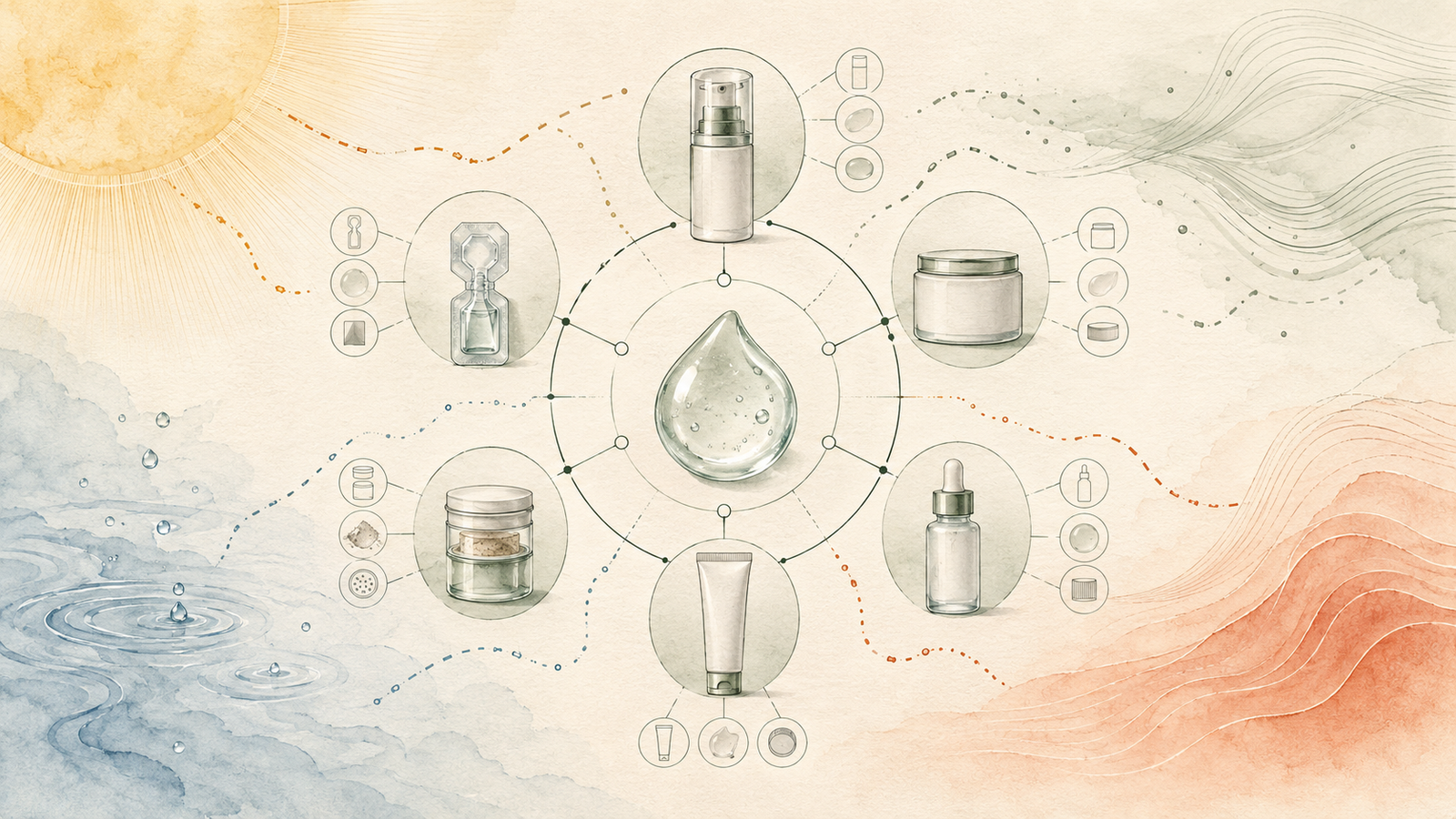
This guide compares six package patterns. Products are cited only as dated examples of how a pattern is presented and instructed. They are not ranked, recommended, or declared equivalent.
Included patterns:
pump_or_airless_style_dispenser
jar_or_wide_mouth_container
dropper_bottle
narrow_orifice_tube
two_part_or_powder_activation
single_dose_or_unit_dose_reference
Included product examples must have an identifiable U.S. or clearly stated market page, an exact product identity, a visible or described package pattern, and current public directions or claims relevant to the example.
Excluded:
- products whose exact package or market cannot be identified;
- professional-only preparations and compounded products;
- ingestibles;
- medical treatment conclusions;
- package rankings based on popularity, reviews, affiliate eligibility, or appearance;
- claims that Formula Clarity opened, handled, measured, or tested a package;
- price or value conclusions.
Missing-data rule:
not disclosed ≠ absent
opaque-looking ≠ light barrier verified
pump-looking ≠ airless verified
airless claim ≠ zero oxygen
jar access ≠ contamination result
dropper markings ≠ delivered-dose accuracy
brand stability claim ≠ independent assay
Pattern 1: pump or “airless-style” dispenser
A pump can limit direct access to the bulk formula and create a repeatable user action. Some designs may reduce air return or isolate the product with a moving piston or bag. The visible word pump, however, does not identify internal architecture or prove barrier performance.
Before purchase, you can verify:
- whether the exact package has a pump;
- whether a refill, lock, overcap, or separate activation step is described;
- whether the manufacturer explicitly uses
airless,vacuum,oxygen-protective, or similar wording; - whether storage, priming, cleaning, or use-within directions are published.
You usually cannot verify from the page alone:
- air-return volume per actuation;
- oxygen ingress over time;
- dose repeatability;
- whether the pump reaches the bottom of the container;
- residual product;
- closure integrity during shipping;
- microbiological protection of the exact preserved formula.
Drunk Elephant’s current C-Firma Fresh instruction page describes a two-part product that the user mixes before first use and then assembles with a pump. See Drunk Elephant — Mixing C-Firma Fresh. That supports the exact activation and assembly steps and the brand’s freshness rationale. It does not prove superiority over every ready-to-use pump or tube.
Use the controlled conclusion:
The page documents a pump-based dispensing pattern and specific setup instructions. Package barrier, dose, retained potency, and comparative performance remain unverified unless separately tested.
Pattern 2: jar or wide-mouth container
A jar provides wide access to the formula and may make it easier to see or remove product. It can also expose a larger opening during use. Those are geometric and operational observations—not a finished-product safety verdict.
Before purchase, verify:
- exact jar size and whether it is the primary or refill package;
- whether a spatula, inner lid, membrane, seal, or overcap is supplied;
- whether the label gives storage or use-within instructions;
- whether the formula is water-containing, anhydrous, or not clear from public information;
- whether the product page makes a stability, hygiene, or preservation claim.
Unknown without direct observation or testing:
- opening dimensions and seal condition of the unit received;
- how often fingers or tools contact the formula;
- preservative effectiveness after repeated use;
- microbial condition of a particular unit;
- evaporation, crusting, separation, or retained active level;
- whether a spatula meaningfully changes exposure under real use.
Olay’s current U.S. page presents Retinol24 Night Moisturizer in a jar and makes first-party product claims. See Olay — Retinol24 Night Moisturizer. The page can document the sold package pattern and brand wording. It does not establish that the jar preserves retinoids better or worse than another container.
A useful conclusion is not “jars are bad.” It is:
A wide opening creates specific access and closure questions. The exact formula, preservation system, seal, storage, and stability evidence still control the product-specific conclusion.
Pattern 3: dropper bottle
A dropper separates the bulk formula from the user through a pipette and bulb, but the pipette is repeatedly removed and exposed. The bottle may be clear, tinted, coated, or opaque; the closure may or may not wipe the pipette effectively.
Visible fields:
- bottle and dropper format;
- stated fill volume;
- whether storage or after-opening directions are published;
- whether the brand instructs the user to apply “drops”;
- whether the page identifies a water-free or aqueous formula.
Unknown fields:
- actual mass or volume per drop;
- drop-size variation with angle, viscosity, temperature, and bulb pressure;
- air exchange during opening and closing;
- light transmission of the exact bottle;
- product left in the pipette or bottle;
- contamination introduced by contact with skin or another surface;
- retained concentration through the directed use period.
The Ordinary’s U.S. Retinol 0.2% in Squalane page instructs refrigeration after opening and use within three months, and the product family uses a dropper format. See The Ordinary — Retinol 0.2% in Squalane. Those are exact first-party directions. They do not prove that the dropper delivers a precise dose or that refrigeration repairs poor handling.
A simulated-use study of one retinol-containing cream found less than ten-percent degradation over four hours under its exact combinations of light, air, inert gas, and temperature. See Assessing retinol stability under simulated-use conditions. The finding demonstrates why exact formulation and method matter; it cannot be transferred to a different dropper serum.
Pattern 4: narrow-orifice tube
A tube can keep the bulk formula behind a relatively small outlet and can collapse as product is removed. Different tubes use different laminates, metals, plastics, caps, nozzles, liners, and seals. A tube is therefore a pattern, not one barrier specification.
CeraVe’s current U.S. Skin Renewing Vitamin C Serum page states that its ten-percent L-ascorbic-acid formula uses protective packaging intended to help prevent oxidation and directs storage in a cool, dark place. See CeraVe — Skin Renewing Vitamin C Serum.
The page supports:
- the brand’s exact protective-package statement;
- the stated L-ascorbic-acid percentage;
- the current ingredient list and formula-change warning;
- the cool, dark storage direction.
It does not publish, on the reviewed page:
- oxygen-transmission data;
- light-transmission data;
- package-closure test results;
- retained L-ascorbic acid at each shelf-life point;
- a comparison against jars, droppers, or pumps.
Treat “protective packaging” as a claim with a plausible technical purpose—not as an independent assay result.
Pattern 5: two-part or powder activation
Separating water or other components until first use can delay one exposure pathway. It also transfers mixing, timing, and handling steps to the user.
Two exact examples illustrate different patterns:
- C-Firma Fresh requires a one-time liquid-and-powder activation before pump use. Drunk Elephant mixing instructions
- The Ordinary 100% L-Ascorbic Acid Powder is water-free before use and directs the buyer to mix a small amount with another product. The Ordinary — 100% L-Ascorbic Acid Powder
These pages support the existence of delayed mixing. They do not establish:
- the concentration created by a particular user;
- mixing completeness;
- pH or uniformity after mixing;
- compatibility with the paired product;
- post-mixing stability;
- dose repeatability;
- comparative performance against a ready-to-use formula.
The correct trade-off is “later mixing plus more user-controlled variables,” not “automatically fresher and better.”
Pattern 6: single-dose or unit-dose reference
A sealed unit can limit repeated access to the remaining units and make one container correspond to one declared portion. It may increase material use and still requires evidence for seal integrity, fill, formula stability, and storage.
No unit-dose product is evaluated as a candidate in this v001 packet. The pattern is included so the framework does not force every package into jar, pump, tube, or dropper categories. Any future example requires exact current product and package evidence.
An observable-versus-unverified audit
Use this table before giving package language more weight than the evidence supports.
| Field | Can often be recorded before purchase | Requires separate evidence |
|---|---|---|
| Exact package pattern | Pump, jar, dropper, tube, powder, two-part, unit dose | Internal architecture not shown on the page |
| Container appearance | Clear, tinted, translucent, opaque-looking | Spectral light transmission |
| Closure description | Pump, screw cap, flip cap, dropper, nozzle | Seal integrity, torque, leak rate, ingress |
| Storage direction | Cool, dark, room temperature, refrigerate, use-within | Whether the unit stayed within conditions before purchase |
| Brand protection claim | Exact wording, claimant, date, market | Independent barrier or retained-assay result |
| Ingredient declaration | Declared names and bounded order context | Exact percentages, pH, microstructure, stability |
| Dispensing instruction | Pumps, drops, pea-size wording, mixing steps | Delivered mass/volume distribution |
| Visible product change | A buyer may observe color, odor, texture, leak, or separation | Remaining potency, microbial identity, or cause |
| Finished-product stability | Sometimes a brand summary is public | Exact method, formula, final package, conditions, time points, acceptance limits |
FDA’s ingredient-labeling rules support identity and limited order information, not package performance. See FDA — Summary of Cosmetics Labeling Requirements and 21 CFR 701.3.
A repeatable packaging-first buying workflow
1. Freeze the exact purchase object
Record product, variant, market, size, package, official page or retailer identifier, access date, and any formula-change warning. A refill, pump, jar, travel size, or regional package is a different object until parity is verified.
2. Identify the instability question
Choose one question:
chemical_retention
physical_stability
microbiological_protection
package_compatibility
dispensing_repeatability
storage_and_use_control
question_not_defined
Do not ask the package to solve all six at once.
3. Capture what is observable
Record the package pattern, closure, transparency appearance, dispensing instruction, storage instruction, use-within language, and exact protection claim. Keep photos or current page captures as dated evidence if the project later authorizes that workflow.
4. Separate claims from results
Classify each statement:
observable_package_fact
brand_package_claim
regulator_or_standard_context
package_component_test
exact_formula_final_package_stability
controlled_first_party_observation
unknown
FTC policy says objective advertising claims need an appropriate basis. That does not make the public claim independently verified. See FTC — Advertising Substantiation Policy.
5. Ask for the evidence object that matches the claim
For oxygen protection, look for a method that measures oxygen ingress or retained analyte in the exact formula/package system. For light protection, look for transmission or photostability evidence. For microbial protection, look for preservation and in-use/package evidence. For dose precision, look for delivered-mass or volume distribution.
A generic ingredient paper, material brochure, stock image, or unrelated package test is not equivalent to the finished retail object.
6. Read storage and use instructions exactly
Follow the exact public direction rather than inventing refrigeration, freezing, decanting, transfer to another container, or a shorter use period. FDA advises proper storage and notes that heat, moisture, air, sunlight, and prior opening can affect cosmetics. See FDA — Cosmetics Safety Q&A: Shelf Life and FDA — Using Cosmetics Safely.
7. Check the seller and package condition without overclaiming
Before purchase, record seller identity, seal or tamper information that is actually visible, shipping concerns, and whether the page describes storage. Do not claim authenticity, intact storage history, or lot quality merely because the listing looks official.
8. Preserve unknowns
A useful record can say:
exact_package_pattern = identified
brand_protection_claim = captured
storage_directions = captured
independent_barrier_data = unknown
package_compatibility_data = unknown
microbiological_in_use_result = unknown
dose_repeatability = unknown
retained_amount_at_end_of_shelf_life = unknown
comparative_package_superiority = not established
9. Return a bounded output
Allowed outputs:
pattern_identified_questions_defined
claim_captured_evidence_limited
exact_package_test_found_with_limits
exact_formula_package_stability_found_with_limits
insufficient_information
not_comparable
blocked_observation_claim
blocked_r2_without_e4
No output means “preferred for everyone.”
Common shortcuts that fail
“Airless means no oxygen”
An airless design or claim may describe a particular dispensing architecture. It does not prove zero initial oxygen, zero permeation, zero headspace exchange, or zero oxygen throughout use.
“Opaque means the formula is protected from light”
Appearance does not provide spectral transmission across the wavelengths relevant to the exact formula. Coatings, labels, walls, seams, closures, and secondary packaging can all matter.
“A pump is contamination-proof”
A closure can change exposure, but contamination also depends on preservation, manufacturing, storage, formula, package integrity, and consumer use. The 1990 closure study is evidence about its exact unpreserved products and closures, not every pump.
“A jar is unsafe”
Direct access is a relevant question, not a product verdict. Finished-product preservation, package design, instructions, storage, and actual use determine the evidence needed.
“A dropper gives a precise dose”
A direction stated in drops is not a validated mass or volume. Viscosity, angle, temperature, bulb pressure, pipette geometry, and residual liquid can change delivery.
“Dark glass guarantees stability”
Tint and material may reduce some light, but visible color is not a measured transmission curve or a retained-potency result.
“Powder and two-part formats are automatically superior”
Delayed mixing changes exposure timing but adds user-mixing and post-activation variables. Exact formula/package stability still requires evidence.
“A color change tells me the remaining active percentage”
Color, odor, texture, leak, or separation can be a reason to stop relying on the unit and check the label or manufacturer. They are not quantitative assays and do not identify the cause.
When this guide is useful—and when to stop
Use this guide to compare package patterns, capture storage directions, identify the correct test object, and prevent appearance or marketing language from becoming a stability verdict.
Stop when the question requires:
- diagnosis or treatment;
- advice involving prescriptions, procedures, pregnancy or lactation;
- response to a serious reaction or suspected infection;
- an individualized safety or suitability conclusion;
- a laboratory determination of contamination, identity, potency, or package failure;
- a claim that a particular unit is authentic, uncompromised, or within specification without evidence.
Those questions require a different evidence and review process.
Conflicts, risks, limitations, and unknowns
Packaging research often produces apparently conflicting examples. Retinoid degradation can be substantial across some commercial products, while an exact retinol cream can remain comparatively stable under a short simulated-use protocol. Those findings do not cancel each other; they describe different formulas, durations, methods, and endpoints.
Likewise, a closure study can show lower contamination incidence for one pump-top lotion than for one screw-cap lotion without proving that all pumps outperform all jars. The study object, preservation status, closure, use period, and organism method remain part of the claim.
Current product pages also use different evidence language. CeraVe calls its package protective, Drunk Elephant gives a freshness rationale for delayed mixing, The Ordinary gives refrigeration and use-within directions for a retinol serum, and Olay sells a jar-based retinol moisturizer. These are exact first-party records, not a controlled comparison.
Unknowns retained in this article include:
- oxygen, water-vapor, and light transmission for the example packages;
- headspace and air-return behavior;
- closure and seal integrity;
- package compatibility and extractables/leachables;
- preservation challenge and in-use contamination results;
- delivered-dose distribution;
- residual usable product;
- retained active concentration through shelf life;
- storage and shipping history of a particular unit;
- comparative package performance;
- individual suitability.
Methodology and evidence limitations
Formula Clarity reviewed current U.S. regulator materials, four package/formulation patterns on exact manufacturer pages, primary stability studies, an in-use closure study, and a formulation-vehicle review. Material statements were mapped to a claim ledger and public sources.
The article evaluates questions a package pattern should trigger. It does not perform package observation, disassembly, transmission testing, leak testing, closure testing, microbiological testing, dose measurement, accelerated or real-time stability testing, or product-use testing. It does not establish a universal package hierarchy, price premium, product recommendation, or individual outcome.
Article 8 remains the vitamin-C-specific packaging and stability guide. This page owns the broader cross-category package-pattern audit. A future Article 46 may own an E5 disclosure dataset after an approved category, sample protocol, physical observation, and QA. No dataset or observation authority is created here.
For a vitamin-C-specific application of these packaging questions, see Vitamin C Forms and Stability: A Packaging-First Buying Guide. That guide keeps formula form, package, storage directions, and finished-product evidence separate; this page supplies the broader cross-category audit vocabulary.
Sources
- FDA — Shelf Life and Expiration Dating of Cosmetics
- FDA — Microbiological Safety and Cosmetics
- FDA — Product Testing of Cosmetics
- FDA — GMP Guidelines/Inspection Checklist for Cosmetics
- FDA — Cosmetics Labeling Claims
- FDA — Summary of Cosmetics Labeling Requirements
- eCFR — 21 CFR 701.3
- FTC — Policy Statement Regarding Advertising Substantiation
- Closure type and in-use microbial contamination study
- Retinoid stability in commercial cosmetic products
- Retinol stability under simulated-use conditions
- Ascorbyl-palmitate stability in topical microemulsions
- Solid-in-oil L-ascorbic-acid formulation study
- Formulation-specific 3% ascorbic-acid study
- Vehicles for Drug Delivery and Cosmetic Moisturizers
- CeraVe — Skin Renewing Vitamin C Serum
- Drunk Elephant — Mixing C-Firma Fresh
- The Ordinary — Retinol 0.2% in Squalane
- The Ordinary — 100% L-Ascorbic Acid Powder
- Olay — Retinol24 Night Moisturizer
- FDA — Cosmetics Safety Q&A: Shelf Life
- FDA — Using Cosmetics Safely